

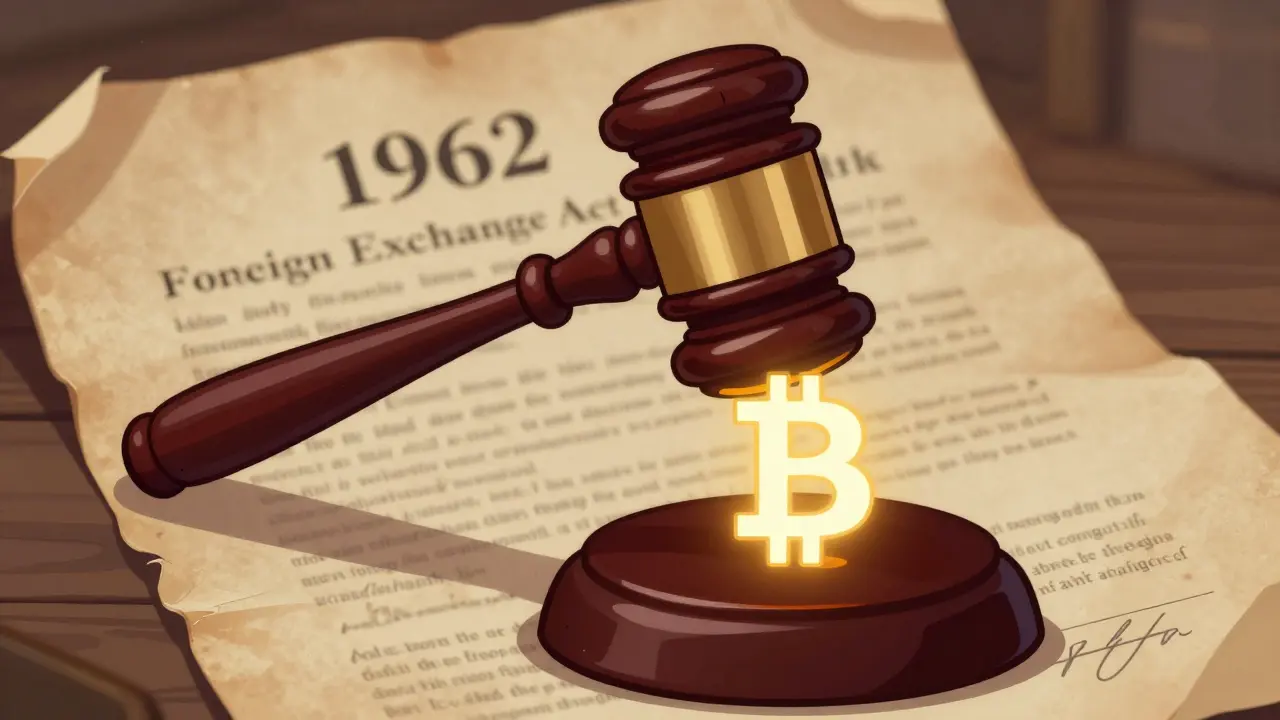
Imagine waking up to find that using a digital wallet or trading a bit of Bitcoin isn't just a risky investment, but a criminal offense that could land you in prison for three years. For residents of Nepal, this isn't a hypothetical scenario-it's the legal reality. While much of the world is debating how to tax or regulate digital assets, Nepal has taken a hard line, placing itself in a tiny group of countries with a total prohibition on cryptocurrencies. The core of this crackdown isn't actually a "crypto law," but a decades-old piece of legislation that was never designed for the internet age.
The Legal Hammer: Foreign Exchange Act 1962
To understand why crypto is illegal in Nepal, you have to look at the Foreign Exchange (Regulation) Act, 1962 a foundational law governing the flow of currency into and out of Nepal. The 1962 Act was written to protect Nepal's financial stability and manage its limited foreign currency reserves. Fast forward to today, and the Nepal Rastra Bank (NRB)-the country's central bank-uses this act as the primary weapon against digital assets.
Specifically, the NRB relies on Section 9(c) of the 1962 Act to argue that because cryptocurrencies aren't issued or backed by any central authority, they are unauthorized forms of foreign exchange. Since the government can't control where the money goes or who is sending it, they view every Bitcoin trade as a violation of national financial security. This isn't just about Bitcoin; the ban covers the entire ecosystem, including Ethereum, Solana, and even stablecoins.
When Did the Ban Happen?
The crackdown didn't happen overnight, but it has become increasingly severe over the last few years. The first major warning shot fired was on August 13, 2017, when the NRB issued Notice No. 37/074/075. This notice formally prohibited Bitcoin transactions, citing the 1962 Act. However, as digital assets grew in popularity, the government realized a single notice wasn't enough.
By September 9, 2021, the Government of Nepal expanded the ban to include every single activity related to cryptocurrency: using it, trading it, and even mining it. The final nail in the coffin came on January 23, 2022, when the government explicitly outlawed any business involving virtual currencies or network marketing. Essentially, if it involves a blockchain and a financial transaction, the government considers it a crime.
The Risks: Fines, Prison, and Court Cases
If you're thinking that a ban is just a "suggestion" that people ignore, the legal consequences in Nepal suggest otherwise. The penalties for violating the Foreign Exchange (Regulation) Act are severe. You could face up to three years in prison, and the court can impose fines totaling three times the value of the illegal transaction.
We've already seen these laws in action. In January 2022, the Department of Revenue Investigation took four individuals to the Kathmandu District Court. Their crime? Misappropriating roughly Rs376.41 million through illegal crypto investments. The government isn't just looking for small-time traders; they are actively hunting for large-scale capital flight that threatens the national economy.
| Country | Legal Status | Primary Regulation/Approach | Key Penalty/Requirement |
|---|---|---|---|
| Nepal | Totally Banned | Foreign Exchange Act 1962 | Up to 3 years prison / 3x value fine |
| India | Legal but Taxed | Income Tax Act | 30% tax on virtual digital asset gains |
| Pakistan | Nuanced/Evolving | SECP Regulations | AML/KYC registration required |
| Bangladesh | Prohibited | Money Laundering Prevention Act | Strict prohibition with CBDC interest |
Why Is the NRB So Against Crypto?
The central bank's obsession with the ban boils down to two things: foreign exchange reserves and remittances. Nepal relies heavily on money sent home by citizens working abroad. In the first five months of the 2021-22 fiscal year, remittance income dropped by 7.3% to $3.26 billion. The NRB believes this drop happened because people started using crypto to move money secretly, bypassing official channels.
Furthermore, Nepal's foreign exchange reserves saw a sharp decline of 14.7% between July and December 2021, falling to $10.03 billion. For a country with a fragile economy, this kind of "capital flight" is a nightmare. The NRB argues that if citizens can easily move wealth into digital assets, the government loses its ability to stabilize the currency and manage national wealth.
The Underground Market: Mining and VPNs
Despite the threat of jail, a significant underground economy has emerged. It's a classic case of "the law says no, but the internet says yes." According to data from Young Innovations Nepal, nearly 19% of tech-savvy Nepalis aged 18-35 have dabbled in crypto. Most of them use VPNs (Virtual Private Networks) to hide their location and access foreign exchanges like Binance or Coinbase.
Interestingly, Nepal has quietly become a hotspot for Bitcoin mining. Why? Because of the country's abundant hydroelectric power. In districts like Kavrepalanchok and Nuwakot, electricity is cheap-averaging around Rs5.50 per kWh. This makes mining profitable, and some estimates suggest that 15-20% of mining operations continue in the shadows, powering servers with the roar of Himalayan rivers.
The High Cost of Total Prohibition
While the NRB claims the ban protects the public from volatility-like the 65% crash Bitcoin saw in 2022-critics argue the cost is too high. By banning the technology, Nepal is essentially cutting itself off from the global blockchain revolution. The Asian Development Bank ranked Nepal 38th out of 40 Asia-Pacific economies for digital financial inclusion, largely because of these restrictive laws.
There is also the issue of safety. Because there is no legal way to trade, users turn to peer-to-peer (P2P) markets. Without any legal recourse or regulation, scams are rampant. There are numerous reports on forums like Hamro Patro of users losing thousands of dollars in P2P trades with no way to get their money back because reporting the crime would mean admitting to a crime themselves.
Is a Change Coming?
There are signs that the government is starting to realize that a total ban is an impossible battle to win. The International Monetary Fund (IMF) has already warned that the current approach is counterproductive, as it simply drives the activity underground where it's even harder to monitor.
The most promising development is the NRB's interest in a Central Bank Digital Currency (CBDC). Governor Maha Prasad Adhikari has stated that the bank is exploring a digital currency, but with one major catch: the central bank must maintain full control. This would be a "digital rupee," not a decentralized cryptocurrency. While this isn't the same as legalizing Bitcoin, it shows that Nepal is finally moving toward a digital financial future, even if it's on the government's own strict terms.
Is it illegal to own Bitcoin in Nepal?
Yes, the Nepal Rastra Bank considers all cryptocurrency activities, including ownership, trading, and mining, to be illegal. While owning assets purchased abroad exists in a technical gray area, any attempt to trade or use them within Nepal violates the Foreign Exchange (Regulation) Act, 1962.
Can I use a VPN to trade crypto in Nepal?
While many people use VPNs to access foreign exchanges, doing so is still a violation of the law. The government views the use of VPNs to circumvent financial regulations as an illegal act, and you could still be penalized if the transactions are traced back to your local bank accounts.
What are the penalties for crypto trading in Nepal?
Under the Foreign Exchange (Regulation) Act, violators can face imprisonment for up to three years. Additionally, the court can impose a fine that is three times the total value of the transaction involved in the illegal activity.
Why does the 1962 Act apply to cryptocurrency?
The NRB argues that since cryptocurrencies are not approved or issued by a central authority, they represent an unregulated flow of foreign exchange. Therefore, any transaction involving them is seen as a violation of the laws governing how foreign currency enters and leaves the country.
Is Nepal planning to launch its own digital currency?
Yes, the Nepal Rastra Bank has indicated that it is exploring the development of a Central Bank Digital Currency (CBDC). Unlike Bitcoin, this would be a government-controlled digital version of the Nepali Rupee, intended to modernize payments while maintaining strict central oversight.
Next Steps for Residents and Investors
If you are currently operating in the crypto space within Nepal, you should be aware that the NRB is increasing its technical capacity. They have partnered with firms like Chainalysis to train officials in blockchain forensics, meaning the "invisible" nature of crypto is disappearing.
- For those in P2P: Be extremely cautious. Without legal protection, you are vulnerable to scams with no way to report them to the authorities.
- For Tech Enthusiasts: Keep an eye on the Ministry of Finance's studies on global regulations. There is a possibility that blockchain technology (separate from the currency) may eventually be legalized for industrial use.
- For Investors: Understand that the risk isn't just market volatility, but legal risk. Ensure any assets held abroad are managed through legal channels that don't violate Nepal's strict foreign exchange laws.
 Finance



william manes
April 12, 2026 AT 16:35Ridiculous. Just stick to the US dollar and be done with it 🇺🇸🤡
Tyler Webb
April 14, 2026 AT 11:59It sounds really stressful for the people there who just want to secure their future. Hopefully they find a safer way soon :)
daniella davis
April 14, 2026 AT 16:29Ugh, please. Using a law from 1962 for digital assets is such a joke, honestly. It's like trying to use a horse carriage manual to fix a Tesla. Totally pathetick that they think this actually works in the real world 🙄
Surender Kumar
April 16, 2026 AT 14:48its crazy how many peopel use vpn's though. some how they always find a way around the rules lol
Adam Auksel
April 17, 2026 AT 17:33The hydroelectric power part is actually super interesting! ⚡️ It's wild how nature provides the perfect setup for mining even when the government says no. Maybe they can pivot to legal green mining instead of banning it 🌿
Kelly Cantrell
April 18, 2026 AT 07:43Typical government overreach. They don't care about "financial stability," they care about total surveillance. First they ban crypto, then they launch a CBDC so they can track every single penny you spend and freeze your account if you say something they don't like. It's a trap for the masses and the IMF is just playing along with the globalist agenda.
Carroll Foster
April 18, 2026 AT 16:23Ah yes, the classic "just ban the internet" strategy. Truly a masterclass in regulatory arbitrage by the NRB. Using a sixties-era act to fight a distributed ledger is peak comedy. I'm sure the Chainalysis partnership will go great since blockchain is totally "invisible" to anyone with a basic understanding of a block explorer. Pure genius! 👏
Terrance Hausmann
April 20, 2026 AT 05:25It is a tough spot for the citizens. On one hand, the government is trying to stop the economy from collapsing due to capital flight, which is understandable from a macro perspective, but on the other hand, pushing people into unregulated P2P markets is essentially handing them over to scammers on a silver platter without any safety net.
Will Dixon
April 22, 2026 AT 03:08just sounds like a bad way to handle things. hope they figuer it out for the ppl there
Kieran Smith
April 23, 2026 AT 22:24wow i didnt know about the hydroelectric thing! sounds like a great way to use that energy. maybe they can make a deal wit the govt to keep it legal? :)
Hope Johnson
April 24, 2026 AT 16:29We must consider the ethical implications of a state asserting such absolute control over an individual's ability to store value. When a government uses outdated laws to criminalize innovation, it doesn't just stop the technology; it erodes the trust between the citizen and the state, creating a shadow society where the most vulnerable are the ones taking the greatest risks in P2P markets just to survive financially. This tension between national stability and individual financial sovereignty is a mirror of the broader struggle for autonomy in the digital age, where the definition of "currency" is being rewritten in real-time while the laws remain frozen in the mid-20th century.
Rima Dinar
April 24, 2026 AT 23:15I really feel for the people who have lost their money in those P2P scams because they are too scared to go to the police. It is such a heartbreaking situation when the law actually protects the criminal instead of the victim because the victim is technically breaking a law by even owning the asset. If the government would just implement a fair tax system like India has, people wouldn't have to hide their transactions in the shadows where they are easily preyed upon by bad actors who know the victims have no legal recourse.
Jason Davis
April 26, 2026 AT 17:00Actually, the 1962 act is way more restrictive than people think. Its not just about the crypto itself but the whole concept of non-authorized foreign exchange. Most people dont realize that even holding certain foreign accounts can get messy under these old laws. The NRB is just applyng the same logic to BTC and ETH since they dont have a formal exchange rate they can control.
ssjuul z
April 26, 2026 AT 23:38Let's keep the energy positive! Innovation always finds a way around restrictions eventually. Just gotta stay safe and be smart about it! (^_^)b
Artavius Edmond
April 27, 2026 AT 06:22Man, that's wild. Just a chill vibe of using nature to mine while the government is stressing over a law from the 60s. Sounds like a movie plot lol.
Agnessa Dale
April 28, 2026 AT 05:07I'm hopeful that they'll eventually see the benefits of blockchain and move toward a more open system.