

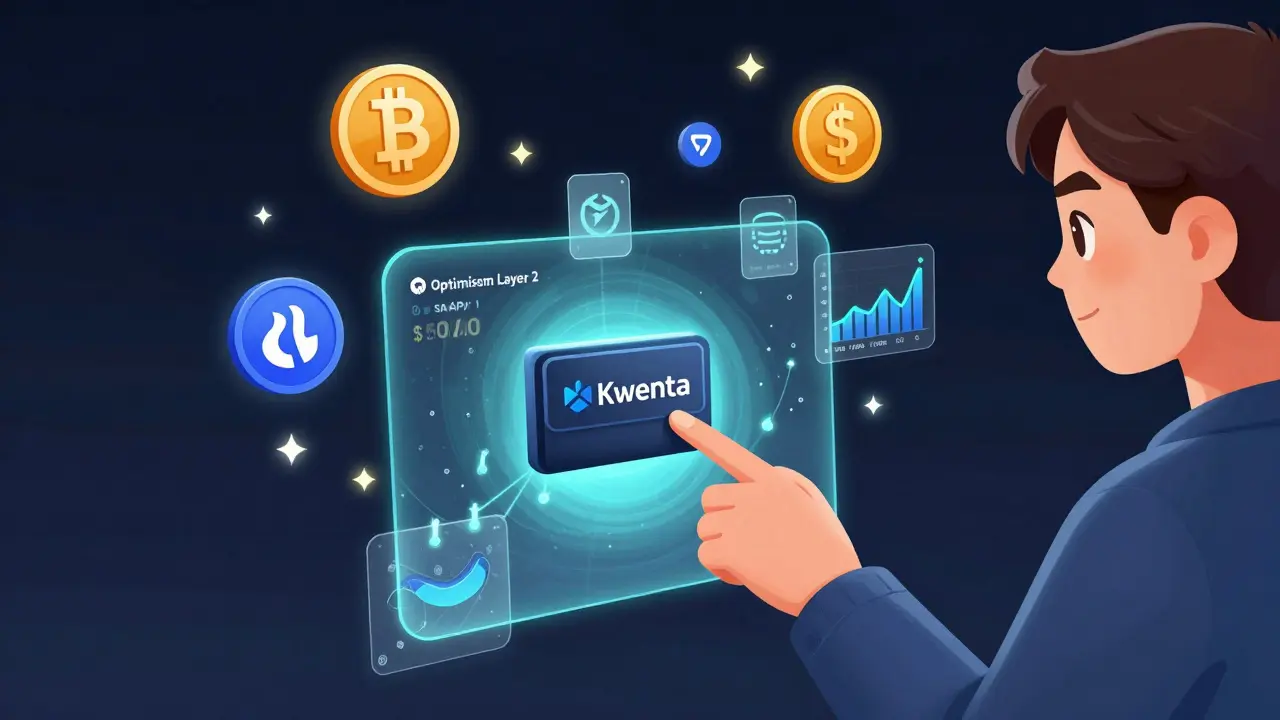
Most crypto exchanges force you to hand over your keys and trust a company with your money. Kwenta flips that model. It’s not a typical exchange - it’s a Kwenta platform built on Synthetix, letting you trade synthetic assets like Bitcoin, gold, Apple stock, or EUR/USD without ever depositing funds into a central server. No KYC. No withdrawal delays. No corporate middlemen. Just direct, on-chain trading with leverage - all powered by smart contracts.
How Kwenta Works: No Custody, No Compromises
Kwenta doesn’t hold your crypto. You connect your wallet - MetaMask, WalletConnect, or any EVM-compatible one - and trade directly from your account. Every trade is settled on the blockchain. That’s the core of decentralization: you’re in control, and the system enforces rules automatically. The magic happens through Synthetix, a protocol that creates synthetic versions of real-world assets. When you trade sBTC on Kwenta, you’re not buying actual Bitcoin. You’re entering a contract that mirrors its price movement. If Bitcoin goes up 5%, your sBTC position gains 5%. If it drops, you lose. The system uses collateral (SNX tokens) to back these synthetics, ensuring they stay pegged to real prices. Kwenta runs on Optimism, Ethereum’s Layer 2. That means trades cost pennies, not dollars. On Ethereum mainnet, a single trade could cost $10-$50 in gas. On Optimism? Often under $0.10. Transactions confirm in seconds. This makes frequent trading feasible - something most DeFi platforms struggle with.What You Can Trade on Kwenta
Kwenta offers perpetual futures on over 50 synthetic assets. That includes:- Cryptocurrencies: sBTC, sETH, sSOL, sADA, sDOGE
- Commodities: sGold, sSilver, sOil
- Forex: sEUR/USD, sGBP/USD, sUSD/JPY
- Equities: sAAPL, sTSLA, sGOOGL
Who Kwenta Is For (And Who Should Avoid It)
Kwenta is ideal for experienced DeFi users who:- Understand how perpetual futures work
- Already use wallets like MetaMask
- Want exposure to traditional assets without buying them
- Prefer non-custodial, censorship-resistant trading
- Want to buy Bitcoin with a credit card
- Need customer support to fix a mistake
- Are new to crypto and don’t know what gas fees are
- Expect a clean, mobile-first app like Binance or Coinbase
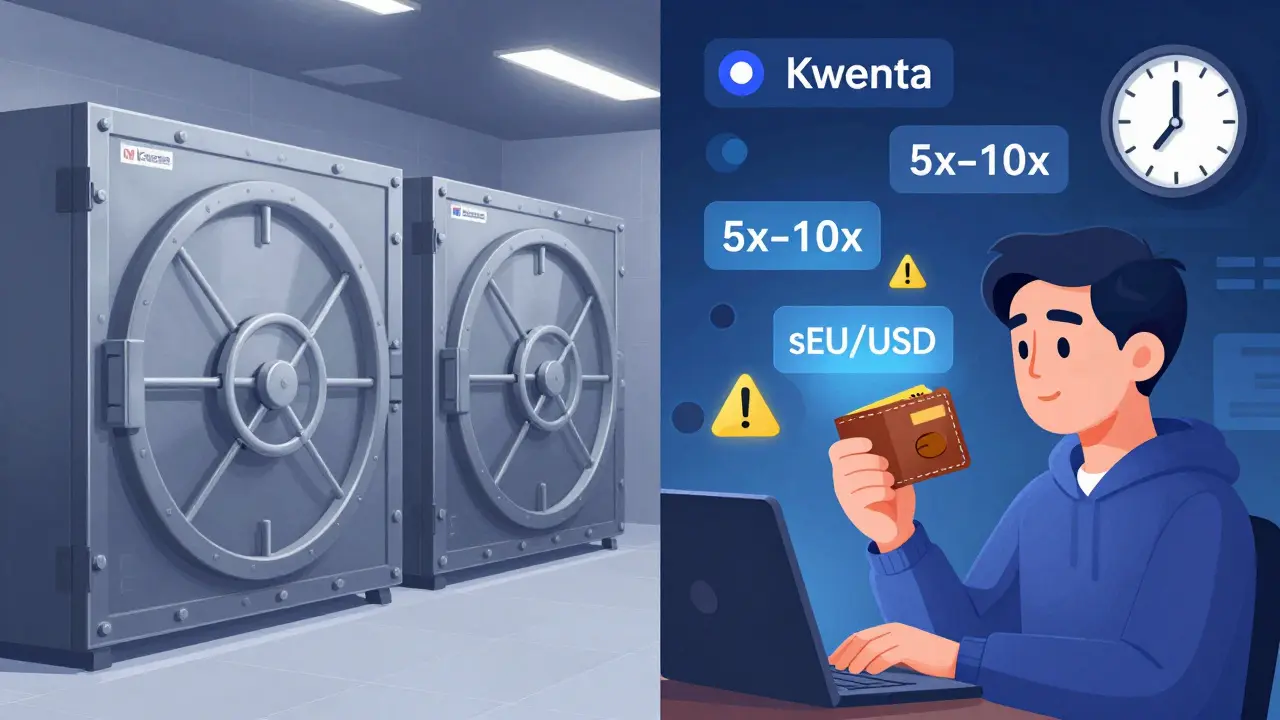
Trading KWENTA Tokens: Where and How
The KWENTA token is the platform’s governance token. Holders vote on proposals - like fee structures, new assets, or protocol upgrades. It’s not a utility token for trading fees; you don’t need it to open a position. The most active trading for KWENTA happens on Velodrome Finance, a decentralized exchange on Optimism. You won’t find it on Binance or Coinbase. To buy KWENTA, you’ll need to swap ETH or OP for it on a DEX like Velodrome or Uniswap. Price predictions for 2025 vary wildly. Some AI models suggest KWENTA could hit $12-$13 by December. Others warn it could drop below $1. That’s typical for governance tokens - their value is tied to adoption, not revenue. If Kwenta’s volume grows, demand for KWENTA rises. If users abandon it, the token falls. There’s no company behind it to stabilize things.Security and Risks
Kwenta is non-custodial, so your funds aren’t at risk from exchange hacks. But smart contract risks remain. If there’s a bug in Synthetix’s code, your trades could be affected. The protocol has been audited multiple times by reputable firms like CertiK and OpenZeppelin, and has operated for years without a major exploit. Liquidation is the biggest danger. If your collateral value drops too low - say, because the asset you’re long tanks - your position gets automatically closed. You lose part or all of your deposit. This isn’t a glitch. It’s how the system protects itself. Gas fees on Ethereum Layer 1 can spike. Always use Optimism. Never trade on mainnet unless you’re testing. Even then, keep the amount small.
Compared to Other DeFi Derivatives Platforms
Kwenta isn’t the only game in town. Here’s how it stacks up:| Feature | Kwenta | Hyperliquid | dYdX |
|---|---|---|---|
| Chain | Optimism + Ethereum | Layer 2 (Ethereum) | StarkEx (Layer 2) |
| Max Leverage | ~10x (estimated) | Up to 50x | Up to 25x |
| Asset Types | 20+ crypto, commodities, forex, equities | 149+ futures, 11+ spot | 10+ crypto perpetuals |
| Non-custodial | Yes | Yes | Yes |
| Token Governance | KWENTA | HLQ | dYdX |
| Learning Curve | High | Medium | Medium |
User Experience and Reviews
Kwenta has very few reviews. Cryptogeek gives it 4.0/5 based on one review. CoinGate rates it 2.6/5 from five users. That’s not enough to judge reliability - it’s a niche platform. Users who like it say: "No delays, no questions asked," and "I can short TSLA at 2 a.m. like it’s normal." Those who dislike it say: "Too complex," "No mobile app," and "I got liquidated and didn’t understand why." The platform doesn’t have a mobile app. You use it on desktop. The interface is text-heavy. Charts are basic. There’s no copy-trading or social features. It’s a tool for serious traders, not a social casino.Final Verdict: Is Kwenta Worth It?
If you’re already deep into DeFi, know how to manage risk, and want exposure to stocks or commodities without using centralized brokers - Kwenta is one of the best options. It’s the only platform that lets you trade Apple stock with leverage, directly from your wallet, with near-zero fees. But if you’re new, or you want a simple, safe place to buy Bitcoin - walk away. This isn’t Coinbase. This is Wall Street, rebuilt on blockchain. You’re responsible for everything. One wrong click, and your collateral vanishes. The future of Kwenta depends on two things: whether Synthetix keeps growing, and whether more traders see value in trading real-world assets on-chain. Right now, it’s a quiet, powerful tool for a small group. It won’t replace Binance. But for the right person? It’s indispensable.Can I trade real Bitcoin on Kwenta?
No. Kwenta only trades synthetic versions of Bitcoin (sBTC). These tokens mirror Bitcoin’s price but aren’t actual BTC. You can’t withdraw sBTC as real Bitcoin. To get real Bitcoin, you need to swap sBTC for ETH on a DEX, then buy BTC on another exchange.
Do I need to own SNX to trade on Kwenta?
No. You don’t need SNX to open a trade. You need collateral in ETH, USDC, or other supported assets. SNX is only required if you want to earn rewards by staking it to back the synthetic assets. Most traders don’t stake SNX - they just use the platform.
Is Kwenta safe from hacks?
Kwenta itself doesn’t hold your funds, so it can’t be hacked like a centralized exchange. But the smart contracts it uses have been audited multiple times by top firms. No major exploit has occurred. Still, all DeFi carries smart contract risk. Always start with small amounts.
What’s the minimum amount to start trading on Kwenta?
You can start with as little as $10-$20 in ETH or USDC. But due to leverage and liquidation risks, it’s risky to trade with less than $100. Small positions amplify volatility. Most active traders use $500 or more.
Can I use Kwenta on my phone?
No official mobile app exists. You can access Kwenta through your phone’s browser if you have MetaMask installed, but the interface is not optimized for small screens. For serious trading, use a desktop or laptop.
How do I withdraw my profits from Kwenta?
You don’t "withdraw" profits. You close your position, and your collateral (ETH, USDC, etc.) increases or decreases based on your trade outcome. You can then swap your collateral for any asset on a DEX like Uniswap or Velodrome. There’s no bank transfer - everything stays on-chain.
 Finance

Alex Strachan
December 31, 2025 AT 08:20Andy Reynolds
January 2, 2026 AT 00:39Shawn Roberts
January 2, 2026 AT 23:05Josh Seeto
January 4, 2026 AT 22:54Jake West
January 5, 2026 AT 19:14Rick Hengehold
January 7, 2026 AT 07:06Daniel Verreault
January 8, 2026 AT 06:03Kevin Gilchrist
January 9, 2026 AT 14:38Abhisekh Chakraborty
January 10, 2026 AT 18:11rachael deal
January 11, 2026 AT 12:31Jacky Baltes
January 12, 2026 AT 01:50Adam Hull
January 12, 2026 AT 03:01Brandon Woodard
January 13, 2026 AT 01:01Emily L
January 13, 2026 AT 10:43Joydeep Malati Das
January 15, 2026 AT 10:42Elisabeth Rigo Andrews
January 16, 2026 AT 07:20dina amanda
January 18, 2026 AT 02:49Ryan Husain
January 19, 2026 AT 23:49