


Imagine donating to a charity and being able to watch every dollar you gave reach the people who need it-down to the exact moment it was spent on food, medicine, or shelter. No guesswork. No middlemen. Just proof. That’s not science fiction. It’s what blockchain is doing for philanthropy today.
Proof That Your Donation Made a Difference
Traditional charity often feels like throwing money into a black box. You give, you get a receipt, and then you hope. But with blockchain, every donation is recorded on a public, unchangeable ledger. Once a donation is made, it’s timestamped and visible to anyone. Donors can track their contribution from the moment it leaves their wallet to the moment it’s used by the organization. In 2022, when war broke out in Ukraine, over $100 million in cryptocurrency reached aid groups within hours. Traditional bank transfers would’ve taken days-or even weeks-due to paperwork and intermediaries. Blockchain didn’t just speed things up; it made the entire process visible.Lower Costs, More Impact
Processing donations isn’t cheap. Credit card fees can eat up 2.9% plus $0.30 per transaction. International wire transfers? Those often cost 6% or more. Blockchain cuts those costs dramatically. Crypto transactions typically cost between 0.1% and 1%. For a $10,000 donation, that’s a savings of $290 versus a credit card-or over $600 compared to a wire transfer. Nonprofits don’t have to absorb those losses. That means more money goes directly to programs. The Identity Theft Resource Center received $1.4 million in Bitcoin in early 2024. Because they used a crypto donation platform that converted funds to USD immediately, they avoided volatility and saved nearly $40,000 in fees. That’s enough to fund 800 meals for families in need.Smart Contracts: Donations That Act on Their Own
Blockchain isn’t just about sending money. It’s about making money work smarter. Smart contracts-self-executing code on the blockchain-can be programmed to release funds only when certain conditions are met. For example, a donor could set up a smart contract that sends $50,000 to a clean water project only after satellite images confirm new wells have been built. No human needs to verify it. The system checks the data automatically. In 2024, the first AI-led crypto donation happened: an AI system detected a flood in Pakistan, triggered a pre-funded smart contract, and sent $200,000 to a relief organization within minutes. This isn’t theoretical. It’s already happening.
Tax Benefits That Encourage Bigger Gifts
Donating cryptocurrency isn’t just efficient-it’s financially smart for donors. The IRS treats crypto as property. If you bought Bitcoin for $5,000 and it’s now worth $25,000, selling it would trigger a $20,000 capital gain tax. But if you donate that Bitcoin directly to a charity? You avoid the capital gains tax entirely-and you can deduct the full $25,000 value from your taxable income. That’s a double win. According to IRS Notice 2024-37, this rule applies to all crypto donations made in 2024 and beyond. Donors who hold crypto long-term are now using it as a strategic giving tool. One Reddit user, PhilanthroTech2025, donated Ethereum worth $1.2 million in January 2025. He saved over $5 million in potential capital gains taxes. That’s not a small gesture-it’s a game-changer for wealth transfer.Who’s Giving? And Why Now?
Crypto philanthropy isn’t just for tech bros. It’s growing fast because two major groups are driving it. First, there are the “evangelists”-longtime crypto holders who’ve seen massive returns and want to give back. They make up 63% of all crypto donors, according to The Giving Block’s 2025 donor survey. Second, there’s the next generation: young professionals who earn income through digital assets and see crypto as their natural way to give. Education nonprofits received 16% of all crypto donations in 2024. Humanitarian groups got 14.2%. Faith-based organizations? 37% now accept crypto. This isn’t a niche trend. It’s a demographic shift. As billions in wealth move to crypto-native heirs, charities that don’t adapt risk losing a major funding stream.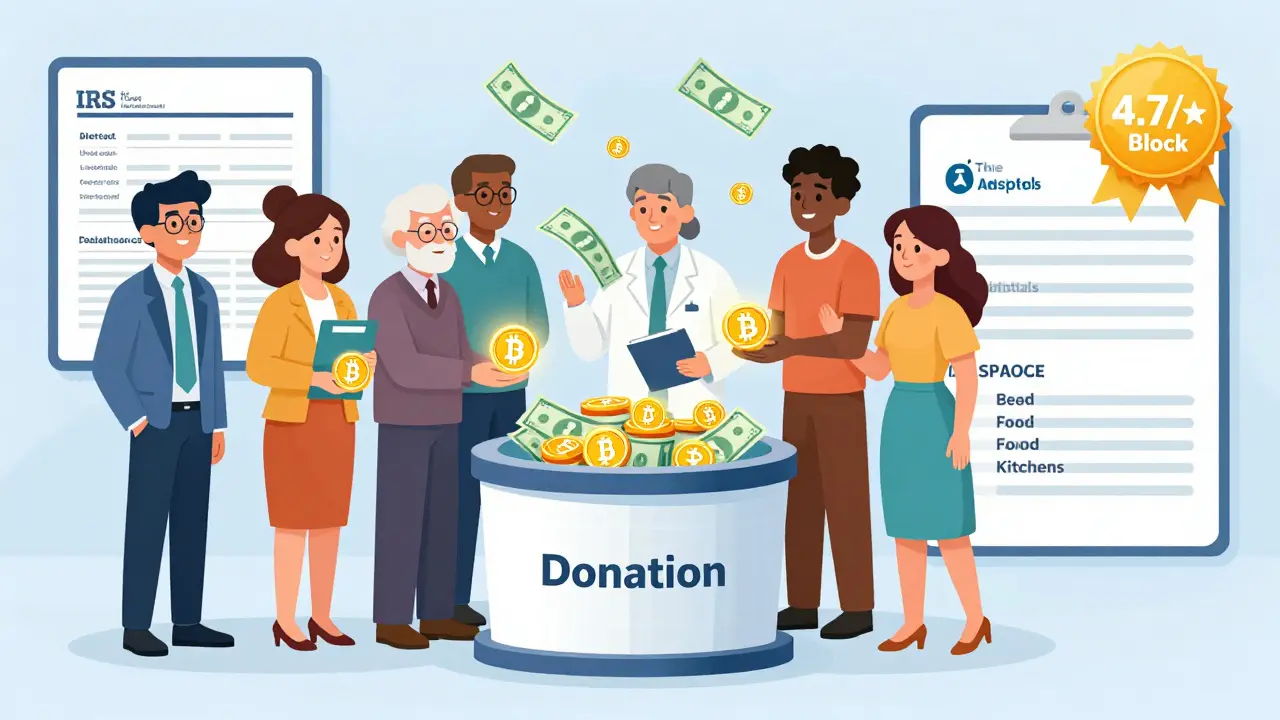
Real Challenges-And How They’re Being Fixed
It’s not all smooth sailing. Some nonprofits struggle with the tech. One user on TechSoup’s forum said it took his accounting team three months to figure out how to value crypto donations for tax reporting. But the tools are catching up. Platforms like The Giving Block and Infinite Giving now offer automated tax documentation, instant USD conversion, and step-by-step integration guides. Over 87% of crypto donation platforms offer immediate conversion to fiat currency, so nonprofits don’t have to worry about Bitcoin crashing the day after they receive it. The Giving Block, used by over 2,000 nonprofits as of early 2025, has a 4.7/5 rating. Their support team resolves 98% of issues within two hours. For organizations with basic website knowledge, setting up crypto donations takes just 2-3 weeks. For those without tech staff, it might take 8-12 weeks-but that’s still faster than launching a new fundraising campaign.Why This Isn’t Just a Fad
Crypto donations hit $1 billion in 2024. In 2025, they’re on track to hit $2.5 billion. That’s a 150% jump in one year. Donor-advised funds saw a 300% increase in crypto contributions in 2024. Major universities, hospitals, and faith groups are integrating it into their systems. The technology isn’t perfect-but it’s maturing. Regulatory clarity is improving. The IRS has clear rules. Stablecoins like USDC now account for 42% of crypto donations, reducing volatility concerns. And AI is starting to automate the process even further. This isn’t a flash in the pan. It’s the beginning of a new standard for giving.What This Means for Nonprofits
If you’re running a charity, you don’t need to become a blockchain expert. You don’t need to manage wallets or understand cryptography. You just need to use a trusted platform. The Giving Block, for example, lets you add a simple button to your website. When someone donates crypto, the platform handles everything: conversion, tax receipts, reporting. Your accounting team gets a clean USD deposit. Your donors get full transparency. And your impact? It’s no longer hidden. It’s documented, trackable, and undeniable. In a world where trust in institutions is declining, blockchain gives donors something they’ve been asking for: proof.Can nonprofits really accept cryptocurrency without technical expertise?
Yes. Platforms like The Giving Block and Infinite Giving handle all the technical work. Nonprofits only need to add a simple donation button to their website. These services convert crypto to cash automatically, issue tax receipts, and integrate with existing accounting software. No wallet management or blockchain knowledge is required.
Is crypto donation safe for charities?
Yes, when using trusted platforms. Reputable providers use institutional-grade security, multi-signature wallets, and instant conversion to USD to eliminate volatility risk. The Giving Block, for example, has processed over $1.2 billion in donations since 2018 with zero security breaches. The main risk comes from using unverified third-party services or managing private keys yourself-something no nonprofit should do.
How do donors benefit from giving crypto instead of cash?
Donors avoid capital gains taxes on appreciated cryptocurrency and can deduct the full fair market value of the donation. For example, if someone bought Bitcoin for $10,000 and it’s now worth $50,000, donating it saves them taxes on the $40,000 gain while still getting a $50,000 charitable deduction. This often leads to larger gifts than they’d make with cash.
Are crypto donations taxable for nonprofits?
No. In the U.S., nonprofits are tax-exempt and don’t pay taxes on donations, including crypto. When a nonprofit receives cryptocurrency and immediately converts it to USD, no tax liability is triggered. The donor, not the nonprofit, handles any tax implications.
What percentage of charitable giving is done via blockchain today?
As of 2025, crypto donations make up about 1.2% of total global charitable giving. While small, this segment is growing rapidly-up 150% year-over-year-and is projected to reach 5-10% of donations within the next five years as donor demographics shift and platforms become easier to use.
Can blockchain help with international aid?
Absolutely. Traditional international transfers can take days and cost over 6% in fees. Blockchain transactions settle in minutes and cost less than 1%. In crisis zones like Sudan or Haiti, where banks are unstable or inaccessible, crypto has become a lifeline. In 2024, over 30% of humanitarian crypto donations went to regions with limited banking infrastructure.
Will AI replace human decision-making in charity donations?
No-but it will enhance it. AI can trigger donations based on real-time data (like natural disasters or disease outbreaks), but it doesn’t decide where to give. Human organizations still set the goals, choose the partners, and define the rules. AI just makes the process faster and more responsive. The first AI-led crypto donation in 2024 was programmed by a human team to act only under specific conditions.
 Finance




Naman Modi
December 23, 2025 AT 17:41Mmathapelo Ndlovu
December 24, 2025 AT 02:22Sybille Wernheim
December 25, 2025 AT 06:12Cathy Bounchareune
December 25, 2025 AT 06:27Helen Pieracacos
December 26, 2025 AT 07:11Steve B
December 27, 2025 AT 14:17Sophia Wade
December 28, 2025 AT 04:36Brian Martitsch
December 28, 2025 AT 13:15Ellen Sales
December 30, 2025 AT 11:59Alison Fenske
December 30, 2025 AT 12:34Aaron Heaps
December 30, 2025 AT 14:34Tristan Bertles
January 1, 2026 AT 03:15Earlene Dollie
January 2, 2026 AT 06:55Amit Kumar
January 4, 2026 AT 05:40Dustin Bright
January 5, 2026 AT 18:52chris yusunas
January 6, 2026 AT 15:20