

Blockchain networks like Ethereum have hit a wall. Too many people trying to send transactions, too few slots in each block, and fees that spike into the hundreds of dollars. This isn’t sustainable. That’s where rollup technology comes in - and it’s not just a temporary fix. It’s the backbone of what blockchain will look like in the next five years.
How Rollups Actually Work
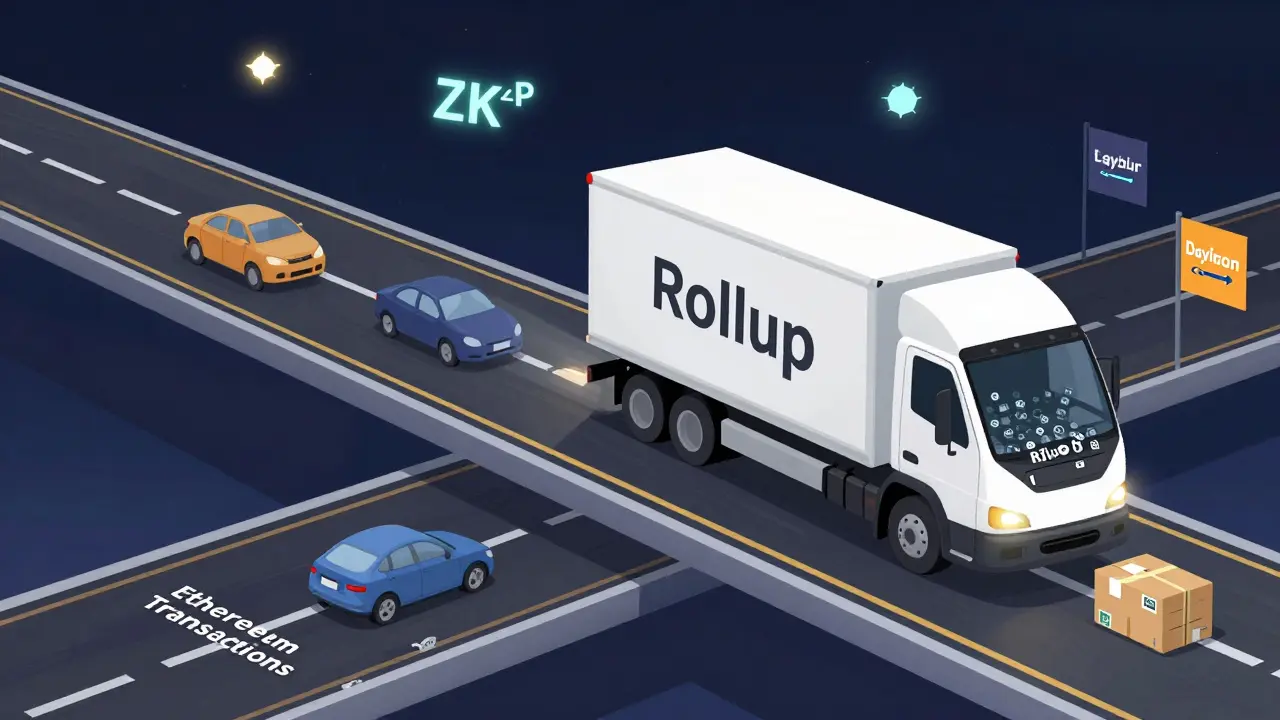
Think of rollups as a delivery truck for transactions. Instead of sending each transaction individually to the main blockchain (Layer-1), rollups gather dozens, sometimes thousands, of transactions off-chain. They bundle them into one compact package, prove it’s valid, and drop it onto the main chain as a single transaction. The main chain doesn’t need to process every detail - it just checks the proof and says, "This batch is legit."This cuts costs dramatically. A transaction that might cost $5 on Ethereum today can drop to under $0.10 with a rollup. That’s not a small improvement - it’s what makes apps like decentralized exchanges, gaming platforms, and even social media on blockchain actually usable for regular people.
The Two Types of Rollups You Need to Know
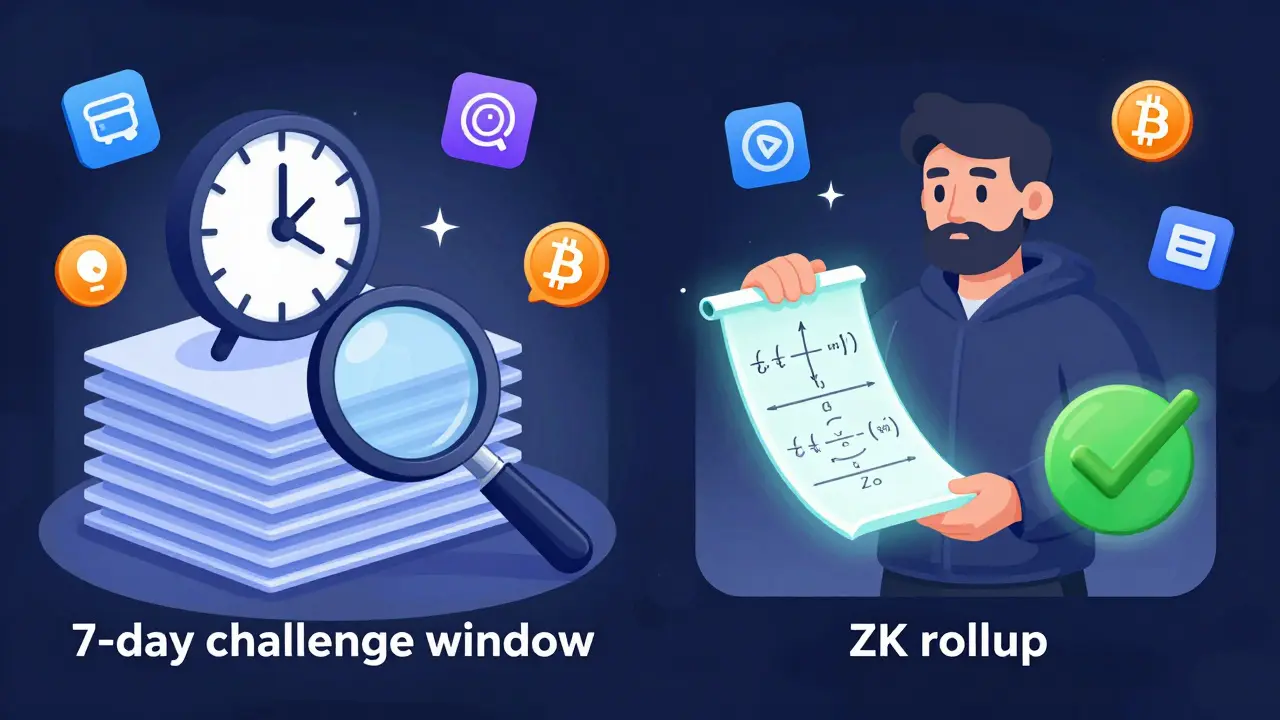
Not all rollups are built the same. There are two main types, and they handle trust differently.Optimistic Rollups assume everything is fine unless someone says otherwise. They post transaction data to the main chain and wait a few days. If someone spots a fake transaction, they can challenge it with a fraud proof. The network then runs the transaction again to prove it was wrong. It’s like saying, "I trust you, but I’ll check if you lie." This makes them fast and cheap, but you have to wait a little longer before your transaction is final.
ZK-rollups go the other way. They don’t wait for someone to catch a mistake. Instead, they generate a mathematical proof - called a zero-knowledge proof - that proves every transaction in the batch is valid without revealing any details. It’s like showing your math teacher you solved 100 equations correctly by handing them a single slip of paper that says "all correct," without showing the work. No waiting. No challenges. Just instant, cryptographically guaranteed finality.
Right now, Optimistic Rollups lead in adoption because they’re easier to build for complex apps like DeFi. But ZK-rollups are catching up fast. They’re more secure, faster to finalize, and use less data on-chain. That’s why most experts believe ZK-rollups will dominate by 2028.
Why This Matters Beyond Ethereum
Most people think rollups are only for Ethereum. That’s outdated. Bitcoin, which was never built for smart contracts, is now experimenting with its own rollups. Projects like Lightning Network and newer ones like Stackos and Bitcoin L2s are bringing smart contract capabilities to Bitcoin using ZK-rollup tech. Imagine sending a Bitcoin payment, then using that same transaction to trigger a loan, a bet, or a token swap - all without touching Ethereum.This isn’t science fiction. In early 2025, Bitcoin rollups processed over 1.2 million transactions in a single week. That’s more than some Layer-1 blockchains handle in a month. Rollups are turning Bitcoin from a digital gold store into a real settlement layer for global applications.
What’s Changing in 2026?
The future of rollup tech isn’t just about more transactions. It’s about smarter, cheaper, and more flexible systems.Compression is getting insane. New data encoding methods are shrinking the size of transaction data by 80% compared to just two years ago. That means more transactions fit into each block, and fees drop even further.
Interoperability is arriving. Rollups are no longer islands. Bridges between different rollups are getting faster and safer. Soon, you’ll be able to swap a token from a ZK-rollup on Ethereum to an Optimistic Rollup on Polygon without leaving the app. No more juggling wallets or paying high gas fees to move between chains.
Hardware acceleration is coming. Generating ZK-proofs used to require expensive servers. Now, specialized chips and open-source software are making it possible to generate these proofs on consumer-grade laptops. This opens the door for decentralized proof networks - where everyday users can help verify rollups and earn rewards.
What’s Still Holding Rollups Back?
Despite the progress, there are real problems.First, user experience is still clunky. Most people don’t understand why they need a separate wallet for a rollup. They just want to send crypto and get on with their day. Wallets and interfaces are slowly improving, but we’re not there yet.
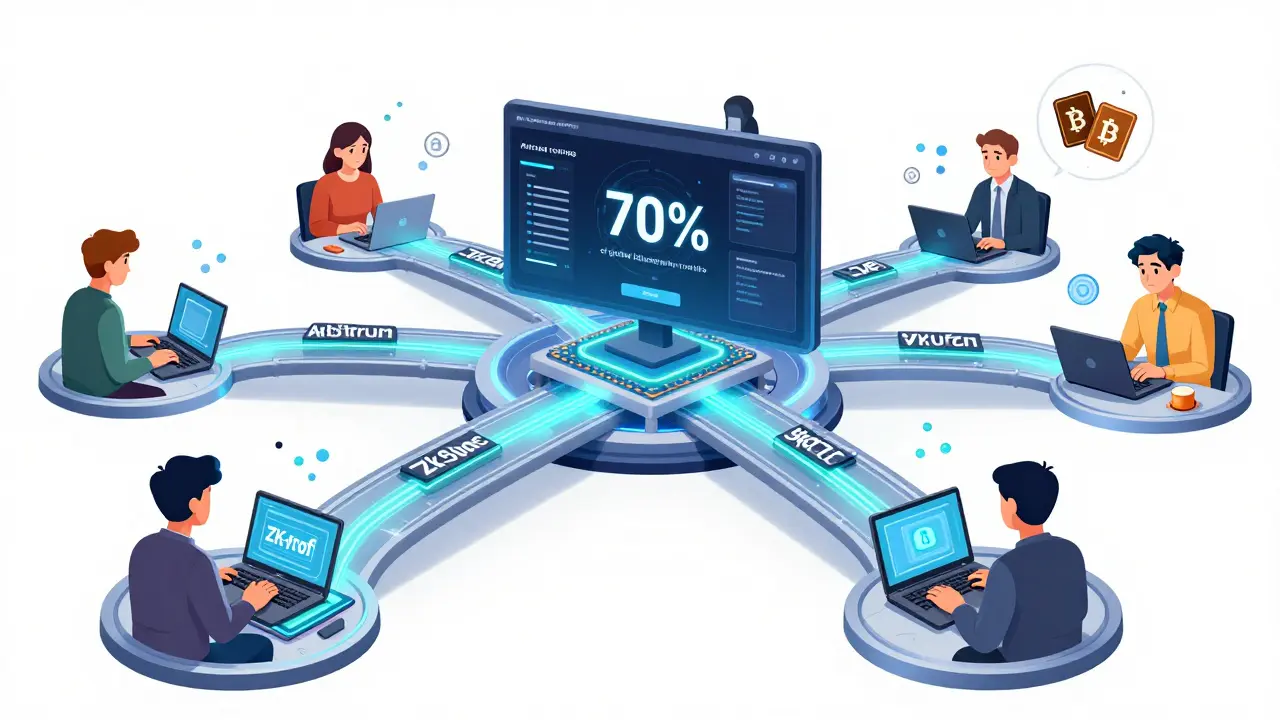
Second, liquidity is split. Money is scattered across dozens of rollups. A DeFi protocol on Arbitrum has different pools than one on zkSync. That makes it harder for apps to compete and for users to find the best rates.
Third, regulation is looming. Governments are watching. If rollups become the main way people trade crypto, regulators will demand transparency. ZK-rollups, by design, hide transaction details. That’s a red flag for compliance. We’ll likely see hybrid models emerge - where some data is shared with regulators, but not the full transaction history.
The Big Picture: Rollups Are the New Infrastructure
Rollups aren’t just a scaling tool. They’re becoming the foundation for the entire decentralized economy. Think of them like highways built on top of the original road (Layer-1). The main road still exists - it’s secure, slow, and expensive. But now, millions of cars are taking the highway instead.By 2027, over 70% of all blockchain transactions are expected to happen on rollups. Ethereum alone will process over 100,000 transactions per second thanks to them. That’s more than Visa. And it’s all happening without changing the core blockchain.
The future isn’t about making Layer-1 faster. It’s about making Layer-2 smarter. Rollups are that leap. They’re the reason blockchain can move beyond speculation and into real-world use - payments, supply chains, identity, voting, even voting systems for small towns.
It’s not about whether rollups will succeed. They already have. The question now is: who will build the next killer app on them?
What’s the difference between ZK-rollups and Optimistic Rollups?
ZK-rollups use cryptographic proofs to verify transactions before they’re added to the main chain. They’re faster and more secure but harder to build for complex apps. Optimistic Rollups assume transactions are valid unless challenged. They’re easier to develop for DeFi and gaming but require a 7-day waiting period for finality if someone disputes a transaction.
Can Bitcoin use rollups?
Yes. Bitcoin rollups are now live. Projects like Stackos and RuneOS use ZK-proofs to enable smart contracts on Bitcoin without changing its core protocol. This lets users send Bitcoin, then instantly use it in lending, staking, or trading apps - all on the Bitcoin network.
Are rollups safer than sidechains?
Yes. Sidechains have their own security and can be hacked independently. Rollups inherit the security of the main chain (like Ethereum or Bitcoin). Even if the rollup operator goes offline or acts maliciously, the main chain can still validate and reverse invalid transactions - something sidechains can’t do.
Do I need a new wallet for rollups?
Not necessarily. Modern wallets like MetaMask and Coinbase Wallet now support multiple rollups automatically. You can send ETH to Arbitrum, zkSync, or Base from the same wallet - no extra setup. But some older apps still require separate wallets, so it’s still a work in progress.
Will rollups make Ethereum fees go to zero?
No - but they’ll make them negligible. Ethereum will still charge a small fee to verify the rollup’s proof. But since thousands of transactions are bundled into one, the cost per transaction drops to pennies. You won’t pay $5 anymore - you’ll pay $0.02. That’s enough for everyday use.
 Finance



Mansoor ahamed
March 22, 2026 AT 19:57Rollups are the real MVP. Bitcoin L2s are quietly rewriting the rules - no hard fork, no drama. Just ZK proofs doing the heavy lifting while BTC stays pure. This is how you scale without breaking the original promise.
And yeah, fees hit $0.02? That’s not scaling. That’s liberation.
namrata singh
March 23, 2026 AT 22:49I’ve been watching this space for years. The shift from ‘can we scale?’ to ‘how do we make it seamless?’ feels like the moment we stopped trying to fix the engine and started building new roads.
Still, I worry about the UX. Most people don’t care about proofs or chains. They just want to send money without reading a whitepaper first.
Jackie Crusenberry
March 25, 2026 AT 17:37So we’re just moving the problem elsewhere? Rollups are just centralized middlemen with fancy math. Where’s the decentralization? I’m not convinced.
Brijendra Kumar
March 26, 2026 AT 08:35lol at people acting like ZK-rollups are some magic bullet. You think generating proofs on a laptop is gonna work? The hardware needed to verify them at scale still costs $20k per node. This is all vaporware dressed up with buzzwords.
Meanwhile, real blockchains like Solana are already doing 50k TPS without any of this convoluted Layer-2 nonsense.
Shana Brown
March 27, 2026 AT 04:19This is the energy I needed today. 🙌
Rollups aren’t just tech - they’re the first real step toward crypto being useful for actual humans. No more ‘gas fee panic’ before sending $5 to a friend.
Keep building. We’re almost there.
JOHN NGEH
March 28, 2026 AT 04:48I’ve been using zkSync for months now. The difference in speed is insane - transactions confirm in seconds, not minutes. And the fees? I’ve sent 15 ETH transfers this month and paid less than $0.50 total.
But I’ve noticed something weird: most of my DeFi activity is still stuck on Arbitrum. Why? Because the liquidity pools are deeper. It’s like having two highways - one’s wider, but the other’s faster. We need better incentives to spread things out.
Dominic Taylor
March 29, 2026 AT 17:41The interoperability angle is where it gets truly wild. Imagine a single wallet that routes your assets across Optimistic, ZK, and even Bitcoin L2s based on fee and speed - automatically. That’s not a dream anymore. It’s in dev on 3 different teams.
And the real kicker? The next-gen bridges won’t even need custodians. Just cryptographic routing tables. It’s like DNS for DeFi.
Florence Pardo
March 31, 2026 AT 05:12I read this whole thing twice. Honestly? I’m still not sure if I’m impressed or terrified.
On one hand, $0.02 transactions? That’s beautiful. On the other, ZK-proofs hiding everything from regulators? That’s a red flag wrapped in a cryptographic bow. Governments aren’t going to sit back and watch crypto go fully anonymous while everyone’s paying taxes on their crypto gains.
Hybrid models are inevitable. Someone’s gonna build a compliant ZK system - and it’ll be the one that wins. Not the purest. Not the fastest. The one that doesn’t get shut down.
Kevion Daley
April 1, 2026 AT 16:26Yessss 🤑
Finally, someone who gets it. Rollups are the real crypto revolution. Not NFTs. Not memes. Not Elon tweets.
Real infrastructure. Real utility. Real money moving at the speed of light.
Now if only the wallets didn’t look like they were coded in 2017…
YANG YUE
April 2, 2026 AT 18:55There’s a philosophical shift here we’re ignoring. Rollups don’t just scale transactions - they scale *trust*. Layer-1 is the cathedral. Rollups are the libraries, the schools, the hospitals built around it.
We used to think decentralization meant everyone running a node. Now we realize it means everyone benefiting from a node - without touching it.
This isn’t just tech. It’s a new social contract.
Nicolette Lutzi
April 3, 2026 AT 00:17Who’s funding all these rollups? Big tech? The Fed? Are we being slowly transitioned into a CBDC overlay under the guise of ‘decentralization’? I’ve seen this script before. First, they give you freedom. Then they control the pipes.
Just saying - don’t get too comfy on that highway. Someone’s got the toll booth keys.
aravindsai pandla
April 3, 2026 AT 07:32Excellent breakdown. One point to add: the compression gains aren’t just about cost - they’re about accessibility.
When you shrink data by 80%, you enable rollups to run on low-bandwidth networks. That means farmers in rural India, students in Nigeria, fishermen in Indonesia - they can now interact with DeFi using 3G. This isn’t just scaling. It’s inclusion.
Also, ZK-proofs aren’t just for privacy. They’re for sovereignty. You own your data. No middleman holds it. That’s revolutionary.
Dheeraj Singh
April 4, 2026 AT 03:51zksync is lit fr
arbitrum is just ethereum with a bigger wallet
rollups r the future but no one talks about how the dev tooling is still trash
also why do we need 12 different rollups? pick one and move on
kavya barikar
April 4, 2026 AT 12:22Rollups are not the end. They are the beginning of a new architecture - one where the base layer becomes immutable, and innovation flows upward.
Like the internet’s TCP/IP, Ethereum’s Layer-1 is the protocol. Rollups are the applications built on top.
And like the web, the most valuable services won’t be built by blockchain companies. They’ll be built by artists, educators, farmers - people who never thought they’d use crypto.
Leona Fowler
April 6, 2026 AT 10:50I’ve helped five friends set up wallets for rollups. Four of them gave up. The UIs are confusing. The terminology is overwhelming. ‘Prove validity’? ‘Fraud window’? ‘Data availability’?
We need to stop talking about the tech and start talking about the experience.
Imagine opening your phone and tapping ‘Send ETH’ - and it just works. No chains. No layers. No explanations.
That’s the goal. Not more proofs. More peace.
Andrea Zaszczynski
April 7, 2026 AT 13:24Why are we still calling them ‘Layer-2’? That implies hierarchy. Rollups aren’t secondary. They’re parallel universes.
And Ethereum? It’s not a blockchain anymore. It’s a security oracle. A trust engine. A global notary.
Let’s stop using old metaphors. We’re not upgrading a highway. We’re building a new dimension.
Sam Harajly
April 8, 2026 AT 20:05Interesting how the conversation around rollups has evolved from ‘Can it scale?’ to ‘How do we govern it?’
The real challenge ahead isn’t technical. It’s political. Who decides which rollup gets to interface with regulators? Who audits the audit protocols? Who funds the decentralized proof networks?
These aren’t engineering questions. They’re societal ones.
Abhishek Thakur
April 9, 2026 AT 16:22Optimistic rollups = easy to build, slow to finalize.
ZK-rollups = hard to build, instant finality.
Simple.
Now go build something.
Annette Gilbert
April 11, 2026 AT 01:40Oh wow. Another ‘rollups will save everything’ manifesto. Let me guess - you also think NFTs are the future of art and Bitcoin is ‘digital gold’?
Newsflash: 90% of rollup activity is just DeFi farms moving money around to avoid gas fees. Not real use cases. Just financial arbitrage dressed up as innovation.
When’s the last time you saw a grandma use a rollup to pay her utility bill? Exactly.
Shayne Cokerdem
April 12, 2026 AT 03:04rollups are just a way for eth to keep charging fees while pretending its not centralizing
also zksync is owned by coinbase
who really controls this stuff??
its all a trap
Kayla Thompson
April 12, 2026 AT 14:17So you’re telling me the solution to Ethereum’s high fees is… more layers? More complexity? More things to break?
Reminds me of when my car had 17 different sensors telling me the engine was fine - while it was on fire.
Maybe instead of building a Rube Goldberg machine of rollups, we should’ve just fixed the damn engine.
JOHN NGEH
April 12, 2026 AT 15:51Actually, the ‘fix the engine’ idea is exactly what rollups let us do. Layer-1 doesn’t need to change. It just needs to stay secure. Rollups handle the noise. It’s like upgrading the internet without rewiring every home.
And yes - Coinbase backs zkSync. But so do Consensys, Polygon, and a dozen open-source teams. That’s not control. That’s collaboration.
Stop seeing corporate involvement as corruption. See it as infrastructure being built by people who actually ship products.