

You’ve heard the rumors. You’ve seen the screenshots. Maybe you even clicked a link promising the best of both worlds: Curve Finance is a decentralized exchange specialized in low-slippage stablecoin trading combined with the lightning-fast speeds of Avalanche is a high-performance blockchain platform known for sub-second finality and low transaction fees. But here is the hard truth you need to know before you connect your wallet: as of mid-2026, there is no official, native Curve Finance deployment on the Avalanche C-Chain.
This isn’t just a minor detail; it’s a critical security and financial checkpoint. If you are looking for "Curve (Avalanche)" in your browser address bar, you might be staring at a phishing site or a confusing third-party aggregator that bridges assets across chains. Understanding this distinction saves you from sending funds into the void. Instead of chasing a ghost protocol, let’s look at what actually works on Avalanche today, how Curve operates elsewhere, and which decentralized exchanges (DEXs) currently dominate the Avalanche ecosystem for stablecoin and volatile asset trading.
The Myth of Native Curve on Avalanche
Curve Finance was built by Michael Egorov specifically for the Ethereum blockchain. Its core innovation lies in its bonding curve algorithm, which is mathematically designed to minimize slippage when swapping assets that have similar values-primarily stablecoins like USDT, USDC, and DAI. On Ethereum, this works beautifully, but it comes with a heavy price tag in gas fees during peak congestion.
Avalanche, launched in September 2020 by Ava Labs, offers a different proposition. It features a unique architecture with three interoperable blockchains: the Exchange Chain (X-Chain), Platform Chain (P-Chain), and Contract Chain (C-Chain). The C-Chain is Ethereum Virtual Machine (EVM) compatible, meaning technically, any smart contract written for Ethereum *could* run on Avalanche. This technical compatibility has led to widespread confusion. Many users assume that because Avalanche is EVM-compatible, Curve simply "exists" there natively.
It does not. While developers can deploy contracts cross-chain, Curve Finance has not officially deployed its primary liquidity pools directly onto the Avalanche mainnet as a first-class citizen. Any interface claiming to be "Curve on Avalanche" is likely one of two things:
- A Cross-Chain Aggregator: Tools like Jupiter or 1inch may route your trade through Curve on Ethereum and bridge the result to Avalanche. This involves multiple steps, bridge risks, and higher latency.
- A Phishing Site: Scammers often clone popular DEX interfaces. If the URL isn’t exactly
curve.fi(for Ethereum) or a verified partner link, do not connect your wallet.
As of July 2026, if you want the specific mathematical benefits of Curve’s stablecoin swaps, you generally need to use Ethereum, Arbitrum, Optimism, or Polygon. If you stay on Avalanche, you must use the native DEXs that have optimized their algorithms for this specific network.
Why Users Want Curve on Avalanche
The desire for Curve on Avalanche makes perfect sense from a user experience perspective. Let’s break down the friction points that drive this search intent.
First, consider the cost. On Ethereum, swapping $1,000 worth of USDC for USDT on Curve might cost you between $1.50 and $15 in gas fees depending on network congestion. During peak times, we’ve seen gas spikes exceed $47 per transaction. Now, look at Avalanche. The average transaction fee hovers around $0.00025. That is a difference of orders of magnitude. For high-frequency traders or those moving smaller amounts, Ethereum’s fees are prohibitive.
Second, consider speed. Avalanche achieves finality in under one second. Ethereum, even with Layer 2 solutions adding complexity, often feels sluggish by comparison. When you are yield farming or rebalancing portfolios, waiting minutes for a transaction to confirm is not just annoying; it’s financially risky due to market volatility.
However, Curve’s specialization is its double-edged sword. It is brilliant for pegged assets. It reduces impermanent loss by approximately 80% for stablecoin pairs compared to general AMMs. But if you try to swap volatile assets like ETH for AVAX on Curve, you will suffer significant slippage. General-purpose DEXs on Avalanche handle these volatile pairs better.
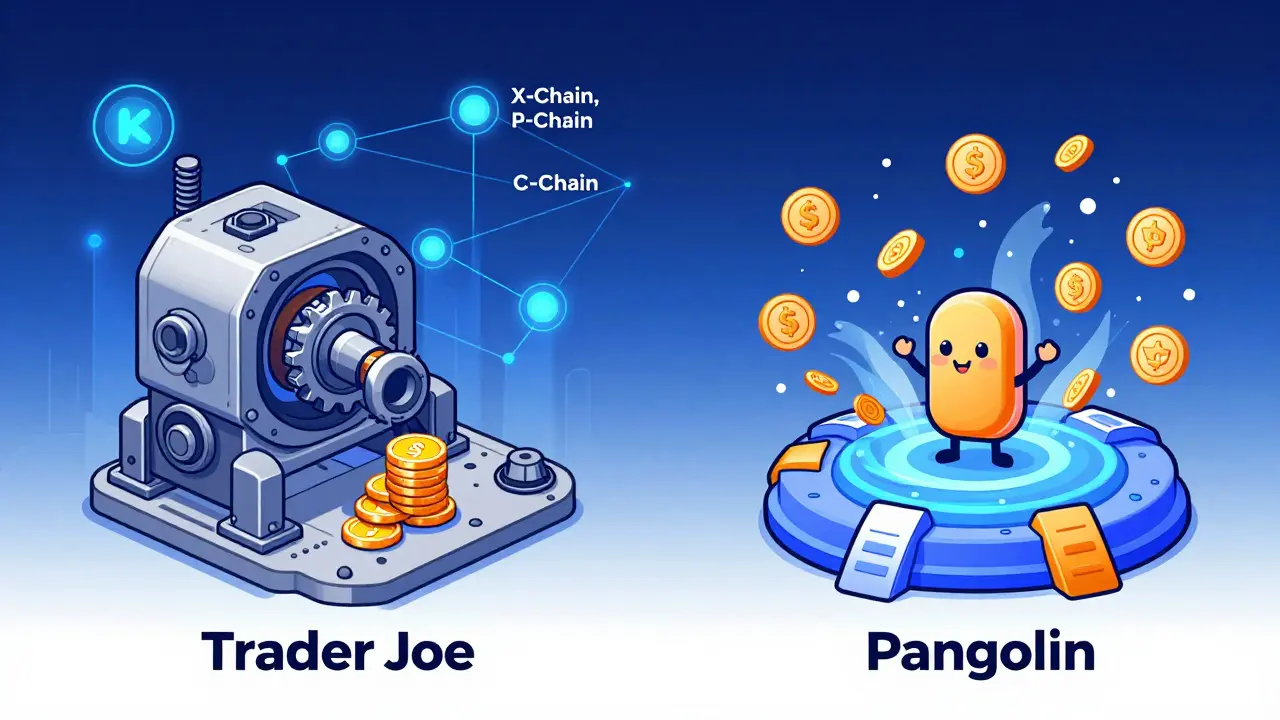
The Real Kings of Avalanche DeFi: Trader Joe & Pangolin
If you are on Avalanche and need to swap tokens, especially stablecoins, you don’t need Curve. You have better, native alternatives. The Avalanche DEX landscape is dominated by two major players: Trader Joe is the leading decentralized exchange on Avalanche, offering concentrated liquidity and leveraged trading and Pangolin is a community-driven DEX on Avalanche focused on fair access and diverse token listings.
| Feature | Trader Joe (Avalanche) | Pangolin (Avalanche) | Curve Finance (Ethereum) |
|---|---|---|---|
| Primary Strength | Concentrated Liquidity (CLMM) | Community Governance & Diversity | Stablecoin Swap Efficiency |
| Avg. Transaction Fee | $0.00025 | $0.00025 | $1.50 - $15+ |
| Finality Speed | < 1 Second | < 1 Second | 12-30 Seconds (L1) |
| Best For | High-volume trading, Leverage | New token discovery, Fair launches | Large stablecoin swaps |
| TVL Share (Approx.) | ~58% of Avax DEX TVL | Significant minority share | Dominant on Ethereum Stablecoins |
Trader Joe has evolved significantly since its inception. It now supports Concentrated Liquidity Market Maker (CLMM) pools, similar to Uniswap V3. This allows liquidity providers to allocate capital within specific price ranges, increasing capital efficiency. For a trader, this means tighter spreads and less slippage, even on volatile pairs. In fact, for many stablecoin pairs on Avalanche, Trader Joe’s slippage is competitive enough that you won’t miss Curve’s specialized algorithm, especially given the near-zero fees.
Pangolin remains a strong contender for users who prioritize decentralization and community governance. It often lists newer tokens before larger platforms, making it a go-to for early adopters. However, for pure execution speed and depth on major pairs like AVAX/USDC, Trader Joe typically holds the edge.
Risks of Cross-Chain Bridging
Some sophisticated users attempt to get "Curve-like" experiences on Avalanche by bridging assets. This introduces a new layer of risk: bridge security. While Avalanche’s own bridge is robust, third-party bridges have historically been targets for exploits. In late 2024, issues were documented where 3.7% of bridged assets experienced delays exceeding 15 minutes. While not a hack, this latency breaks the promise of instant DeFi.
If you absolutely must use Curve’s specific pools, you should stick to the networks where it is natively deployed: Ethereum, Arbitrum, Optimism, and Polygon. Arbitrum and Optimism offer lower fees than Ethereum Mainnet while still providing direct access to Curve’s deep liquidity. Attempting to bridge just to access a marginal improvement in slippage on stablecoins is rarely worth the added complexity and risk.

How to Trade Safely on Avalanche Today
Since "Curve on Avalanche" is largely a myth, here is your practical checklist for executing trades on the Avalanche network efficiently and safely.
- Use Verified Interfaces: Always navigate to
traderjoexyz.comorpangolin.exchangevia bookmarks. Never click links from social media DMs or unverified forums. - Check Slippage Tolerance: For stablecoin swaps on Trader Joe, set your slippage tolerance to 0.1% - 0.5%. For volatile pairs, you may need 1% - 2%. Unlike Curve, where stablecoin slippage is negligible, Avalanche DEXs rely on standard AMM curves unless using CLMM pools.
- Monitor Gas Prices: While Avalanche fees are low, they can spike during major NFT mints or meme coin crazes. Use a wallet like MetaMask or Rabby to view current base fees before confirming large transactions.
- Verify Token Contracts: Before swapping, ensure you are interacting with the correct token contract addresses. Scammers often create fake tokens with identical names to USDC or USDT on Avalanche.
- Utilize Aggregators for Best Rates: Platforms like Aggregators are tools that scan multiple DEXs to find the best swap rate such as 1inch or Matcha can split your order across Trader Joe, Pangolin, and other pools to give you the best possible price, mimicking the efficiency you’d expect from a specialized protocol.
Future Outlook: Will Curve Ever Come?
The crypto landscape shifts rapidly. Curve Finance has expanded to numerous Layer 2 networks. There have been GitHub commits and discussions regarding EVM compatibility testing for Avalanche. However, as of July 2026, no official announcement or mainnet deployment has occurred. Ava Labs continues to focus on its subnet architecture, allowing specialized networks for specific use cases. It is possible that a future subnet could host a Curve-like protocol, but it would likely be a fork or a partner integration rather than the original Curve Finance team deploying directly.
For now, the market has spoken. Trader Joe and Pangolin have captured the majority of the volume. They have optimized their code for Avalanche’s unique consensus mechanism. Trying to force an Ethereum-native solution onto a high-performance Layer 1 often results in a mismatched user experience. Embrace the native tools. They are faster, cheaper, and just as effective for the vast majority of trading needs.
Is Curve Finance available on Avalanche?
No, Curve Finance is not natively deployed on the Avalanche C-Chain as of 2026. Curve is primarily an Ethereum-based protocol. While Avalanche is EVM-compatible, Curve has not officially launched its pools there. Users seeking Curve-like functionality should use Ethereum, Arbitrum, or Optimism.
What is the best DEX for stablecoin swaps on Avalanche?
Trader Joe is currently the leading DEX on Avalanche for stablecoin swaps. It offers deep liquidity, low slippage, and utilizes Concentrated Liquidity Market Maker (CLMM) pools to maximize efficiency. Pangolin is a strong alternative for diverse token listings.
Why is Curve not on Avalanche?
Curve focuses on networks with high institutional adoption and deep existing liquidity, primarily Ethereum and its Layer 2 scaling solutions. Additionally, Avalanche already has highly optimized native DEXs like Trader Joe that provide sufficient competition and functionality for its users without needing external protocols.
Are there risks in using cross-chain bridges to access Curve?
Yes. Using bridges to move assets between Avalanche and Ethereum to access Curve introduces bridge risk, including potential delays, smart contract vulnerabilities, and additional transaction costs. It is generally safer and more efficient to use native DEXs on the network you are already on.
How do transaction fees compare between Curve on Ethereum and DEXs on Avalanche?
Transaction fees on Avalanche are significantly lower, averaging around $0.00025 per transaction. In contrast, using Curve on Ethereum can cost between $1.50 and over $15 per transaction during peak network congestion, making Avalanche far more cost-effective for frequent traders.
 Finance