

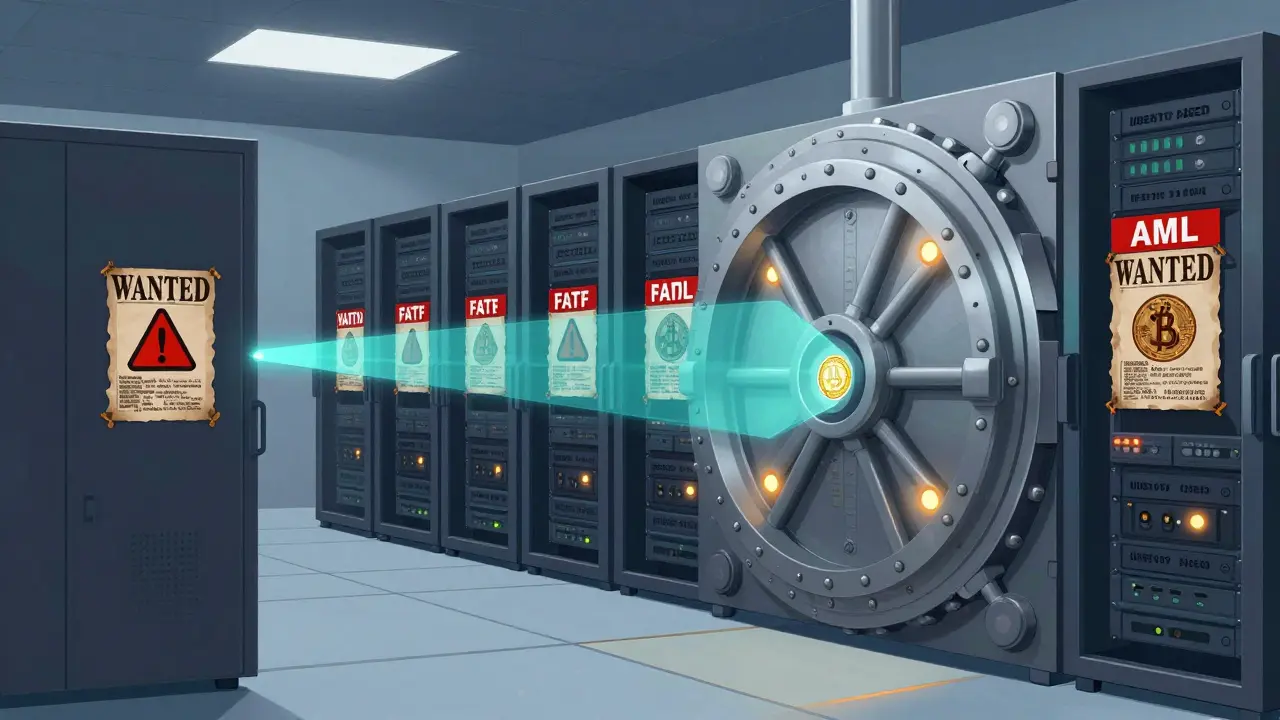
The days of anonymous crypto transactions are effectively over. If you run a cryptocurrency exchange, manage a wallet service, or issue stablecoins, the regulatory landscape has shifted from "wild west" to heavily scrutinized financial infrastructure. As of May 2026, Anti-Money Laundering (AML) regulations for cryptocurrency are no longer just suggestions; they are strict legal mandates enforced by global bodies and national governments alike.
You might wonder why this matters if your platform is fully decentralized. The truth is, regulators have drawn a clear line: if you facilitate the conversion between digital assets and fiat currency, or even between different digital assets with centralized control points, you are on the hook. The Financial Action Task Force (FATF), the global money-laundering watchdog based in Paris, set the tone back in 2019, but the rules have tightened significantly since then. By January 2024, 137 jurisdictions had implemented these frameworks, creating a patchwork of requirements that can be overwhelming to navigate.
The Core Framework: FATF Standards and VASP Obligations
To understand where we stand in 2026, we need to look at the foundation laid by the Financial Action Task Force. Founded in 1989, the FATF doesn't write laws itself, but its recommendations become international law when countries adopt them. Their June 2019 guidance, updated in March 2021, defined who exactly falls under the net: Virtual Asset Service Providers (VASPs).
If you offer services like exchange between virtual assets and fiat, exchange between one or more types of virtual assets, transfer of virtual assets, or safekeeping of private keys, you are a VASP. The FATF’s stance is simple: treat crypto providers like banks. This means implementing Customer Due Diligence (CDD), monitoring transactions for suspicious patterns, and reporting anything that looks off to local authorities. The goal? To stop criminals from turning dirty crypto into clean cash. The FATF estimates that money laundering accounts for 2-5% of global GDP annually, a massive incentive for governments to close loopholes.
In practice, this means your platform cannot remain anonymous. You must know who your customers are. You must monitor their activity. And you must keep records. The European Union leads the charge here, with an 85% implementation compliance rate compared to just 65% in emerging markets, according to the World Bank’s 2023 Digital AML Compliance Index. If you are operating globally, you likely need to comply with the strictest regime among your user base.
The Travel Rule: Sharing Data Across Borders
One of the most contentious and technically challenging aspects of crypto AML is the Travel Rule. Originally designed for traditional wire transfers, Recommendation 16 of the FATF standards requires financial institutions to attach specific customer information to every transaction above a certain threshold.
For cryptocurrency, this means that when User A sends funds to User B on a different platform, both platforms must exchange data. The originator’s name, account number, and physical address (or date of birth) must travel with the transaction. The beneficiary’s name and account number must also be shared. The threshold varies by jurisdiction-$1,000 or €1,000 in many places, ¥1 million in Japan, and CHF 1,000 in Switzerland-but the principle remains the same: transparency.
Implementing this is not trivial. In February 2024, Dr. David Lewis, Executive Secretary of the FATF, admitted that the Travel Rule implementation gap remains the biggest vulnerability in the system. Only 45% of VASPs globally had fully operational compliance systems at that time. However, by mid-2024, 78% of major exchanges began supporting standardized message formats like IVMS 101, allowing them to communicate securely via APIs. If you are building a compliant system today, integrating with Travel Rule networks like Truesight or Notabene is no longer optional-it is essential for cross-border operations.

Regional Differences: EU, US, UK, and Asia
While the FATF sets the global standard, individual regions add their own layers of complexity. Understanding these differences is crucial for determining where you can operate and what it will cost you.
| Region | Key Regulation/Body | Licensing Timeline | Capital Requirement | Travel Rule Status |
|---|---|---|---|---|
| European Union | MiCA / 6AMLD | 6-9 months | Varies by member state | 89% adoption (Dec 2023) |
| United States | FinCEN / BSA | Variable | No federal minimum | Proposed "Travel Rule 2.0" |
| United Kingdom | FCA Registration | Avg. 18 months | Risk-based | Strict enforcement |
| Singapore | MAS / Payment Services Act | Fast-track available | SGD 100,000 min | High compliance |
| Japan | Payment Services Act | Strict vetting | ¥10 million min | Pioneer in Travel Rule |
In the European Union, the Markets in Crypto-Assets Regulation (MiCA) became fully applicable on December 30, 2024. MiCA requires all Crypto-Asset Service Providers (CASPs) to obtain authorization from national competent authorities. The process takes 6-9 months on average. Once licensed, you must maintain transaction records for five years and implement real-time monitoring systems capable of flagging suspicious transactions within 15 minutes. The impact was immediate: the number of active crypto exchanges in the EU dropped from 350 to 217-a 38% consolidation-as smaller players exited due to compliance costs.
The United States takes a multi-agency approach. The Bank Secrecy Act, amended by the Anti-Money Laundering Act of 2020, requires all VASPs to register with FinCEN. In March 2024, FinCEN proposed new rules requiring identity verification for all transactions, regardless of amount, dubbed "Crypto Travel Rule 2.0." This would eliminate the $1,000 threshold entirely, raising privacy concerns but boosting security.
In the United Kingdom, the Financial Conduct Authority (FCA) enforces registration under the Money Laundering, Terrorist Financing and Transfer of Funds Regulations 2017. The FCA is known for its rigorous scrutiny, with registration processes averaging 18 months. Singapore’s Monetary Authority (MAS) offers a slightly more flexible, risk-based approach under the Payment Services Act 2019, though it still demands significant capital reserves. Meanwhile, China remains an outlier, banning all cryptocurrency exchanges since September 2017.
Technical Implementation: Monitoring and Analytics
Compliance is not just about paperwork; it is about technology. Regulators expect your systems to detect illicit activity automatically. The European Banking Authority’s December 2023 report specified that EU-based CASPs must use algorithms capable of detecting at least 12 predefined suspicious activity typologies. These include structuring (breaking large transactions into smaller ones to avoid detection), mixing services, and darknet market transactions.
To achieve this, most VASPs rely on blockchain analytics tools. Platforms like Chainalysis Reactor, Elliptic, and TRM Labs are industry standards. They scan the blockchain in real-time, tagging addresses associated with known illicit actors. According to the New York Department of Financial Services’ Cybersecurity Regulation Part 504, these systems must process data with 95%+ accuracy. For exchanges processing over $500 million monthly, implementation costs range from $250,000 to $750,000, as noted in Deloitte’s 2023 Crypto Compliance Cost Analysis.
However, these tools are not perfect. A March 2024 survey by the Association of Certified Anti-Money Laundering Specialists (ACAMS) found that 62% of crypto compliance officers reported false positive rates exceeding 30%. That means for every legitimate suspicious activity report filed, there were an average of 42 false alerts. This creates a heavy workload for human analysts, driving up operational costs. Compliance now represents 12-15% of operating expenses for medium-sized exchanges, compared to 8-10% for traditional banks.

The DeFi Challenge and Future Trends
Decentralized Finance (DeFi) presents the biggest headache for regulators. Unlike centralized exchanges, DeFi protocols often lack a central entity to hold accountable. Yet, Chainalysis’ 2024 Crypto Crime Report revealed that decentralized exchanges accounted for 56% of illicit transaction volume in 2023, up from 33% in 2022. Criminals are moving to DeFi to evade AML controls.
Regulators are catching up. The FATF’s February 2024 update clarified requirements for DeFi protocols and NFTs, signaling that anonymity will not protect developers from liability if their platforms facilitate money laundering. In the US, FinCEN’s proposed rules target intermediaries, including front-end interfaces of DeFi platforms.
Looking ahead, AI is becoming a critical tool. Gartner predicts that by 2026, 75% of VASPs will implement AI-powered transaction monitoring systems. These systems aim to reduce false positives by 40-60%, making compliance more efficient. Additionally, the Bank for International Settlements proposed a "compliance score" system in June 2024, where crypto assets would carry AML scores affecting their liquidity. High-risk tokens may become harder to trade on regulated platforms.
The global crypto compliance software market is booming, projected to reach $4.83 billion by 2028. This growth reflects the industry’s shift from speculation to institutionalization. If you want to survive in this space, you must embrace compliance not as a burden, but as a competitive advantage. Users increasingly trust platforms that prioritize security and legality.
Practical Steps for Compliance Officers
If you are responsible for ensuring your platform meets AML standards, start with these actionable steps:
- Map Your Jurisdictions: Identify every country where your users reside. Determine which regulations apply. If you serve EU users, MiCA compliance is non-negotiable.
- Implement Robust KYC: Use reputable identity verification providers. Collect full name, address, date of birth, and government ID. Ensure your onboarding process is secure and user-friendly to minimize friction.
- Deploy Transaction Monitoring: Integrate blockchain analytics tools. Configure alerts for the 12+ suspicious activity typologies required by regulators. Regularly tune your algorithms to reduce false positives.
- Prepare for the Travel Rule: Join a Travel Rule network. Test your API integrations with partner VASPs. Ensure you can send and receive originator/beneficiary data securely.
- Train Your Staff: Compliance is a team effort. Train customer support and engineering teams to recognize red flags. Hire dedicated compliance officers if your budget allows-salaries range from $110,000 to $180,000 in the US.
- Keep Records: Store transaction records for at least five years. Ensure your data storage is secure and accessible for regulatory audits.
Remember, regulatory arbitrage-the practice of operating in lax jurisdictions to avoid strict rules-is closing fast. Professor Angela Angelovska-Wilson noted that 37% of VASPs currently maintain separate compliance systems for each region, but this is unsustainable. Harmonization is coming. Build a robust, scalable compliance framework now to future-proof your business.
What is the FATF Travel Rule for cryptocurrency?
The FATF Travel Rule (Recommendation 16) requires Virtual Asset Service Providers (VASPs) to share specific customer information-such as name, account number, and address-with other VASPs for transactions above a certain threshold (e.g., $1,000). This ensures that the originator and beneficiary of a crypto transfer are identifiable, similar to traditional bank wire transfers.
When did MiCA regulation fully come into effect?
The Markets in Crypto-Assets Regulation (MiCA) fully applied across the European Union starting December 30, 2024. It requires all Crypto-Asset Service Providers (CASPs) to obtain authorization from national authorities and implement strict AML/CFT measures, including real-time transaction monitoring.
How much does crypto AML compliance cost?
Compliance costs vary by size and complexity. For medium-sized exchanges processing $100 million-$1 billion monthly, compliance represents 12-15% of operating expenses. Technical implementations using blockchain analytics tools can cost between $250,000 and $750,000 initially, plus ongoing staffing and maintenance fees.
Are decentralized exchanges (DEXs) subject to AML regulations?
Currently, DEXs face a regulatory gray area, but regulators are tightening the net. The FATF’s 2024 updates clarify that entities facilitating access to DEXs may be considered VASPs. Furthermore, DEXs accounted for 56% of illicit crypto volume in 2023, prompting increased scrutiny and potential future liabilities for developers and front-end operators.
What happens if a VASP fails to comply with AML regulations?
Non-compliance can result in severe penalties, including heavy fines, license revocation, and criminal charges against executives. In the EU, MiCA violations can lead to fines up to 10% of annual turnover. In the US, FinCEN can impose substantial civil penalties. Reputational damage and loss of user trust are also significant risks.
 Finance


Mike S
May 14, 2026 AT 19:42Oh look, another article telling us that the 'wild west' is over because some bureaucrats in a suit decided they want a cut of your transaction fees. 🙄 I've been running nodes since 2013 and if anyone tells me crypto is about to become as boring and regulated as my local bank, I laugh in their face. The whole point was decentralization, not handing our data to every government agency with a grudge. This isn't progress, it's surrender wrapped in fancy legal jargon.
Michael Berggren
May 16, 2026 AT 07:33I think there is a lot to consider here regarding the balance between security and privacy. It is true that regulations can feel heavy, but they also bring legitimacy which helps more people enter the space safely. We should try to see this as an opportunity to build better systems rather than just complaining about the rules. Maybe we can find a way to keep innovation alive while still being responsible citizens of the digital world. 😊
Kiran CS
May 17, 2026 AT 09:47It is truly amusing to witness the sheer ignorance displayed by those who believe that 'decentralization' somehow exempts them from the basic tenets of financial responsibility. One must possess a certain level of intellectual maturity to understand that facilitating value transfer inherently invites regulatory scrutiny. To suggest otherwise is not only naive but bordering on delusional. The elite understand that order is paramount, and chaos is merely the playground for the uneducated masses who lack the foresight to plan for compliance.
Bijan Das
May 18, 2026 AT 12:13who cares about all this fancy talk when you cant even get a decent cup of coffee without waiting twenty minutes lol. i mean seriously why are we spending so much time reading about travel rules and fatf standards when we could be doing something fun? its just too much work to read all these paragraphs and honestly i dont care if my crypto gets traced back to me as long as i can buy what i want. sounds like a headache to me.
Ashley Rodriguez
May 18, 2026 AT 16:40i totally agree with the idea that we need to adapt to these changes because change is inevitable and fighting it only makes things harder for everyone involved. it seems like a lot of people are worried about losing their privacy but maybe we should think about how these rules can actually protect us from bad actors who want to steal our money or use our platforms for illegal activities. i have found that when we work together and follow the guidelines we end up creating a safer environment for all users which is really important for the growth of the industry. it might take some time to adjust but i believe we can make it work if we stay positive and supportive of each other through this transition period.
Bridget Coogle
May 19, 2026 AT 11:58its okay to feel overwhelmed by all the new rules but remember that you are not alone in this journey. many people are going through the same challenges right now and finding ways to adapt. let's support each other and share our experiences so we can learn together. i think we can do this if we stay calm and focused on the solution rather than the problem.
Zara Zaman
May 21, 2026 AT 07:41The US needs to stop letting foreign entities dictate our financial sovereignty. These FATF rules are largely influenced by European and Asian interests that do not align with American values. We should be enforcing our own strict laws without bowing to international pressure. If you want to operate in the US market, you comply with US standards, period. No exceptions for global harmonization nonsense.
Larry Port
May 21, 2026 AT 13:46I am curious about the technical side of implementing the Travel Rule. How exactly do different platforms exchange this data securely without exposing too much information? It seems like a big challenge to create a standard that works for everyone. I wonder if there are any open-source solutions being developed to help smaller exchanges comply without breaking the bank.
Jocelyn Garcia
May 22, 2026 AT 22:40From a tech perspective, the integration of IVMS 101 is becoming the de facto standard. Most major players are already using APIs that handle the payload encryption and routing automatically. The real bottleneck is not the protocol itself but the legacy infrastructure of older exchanges that haven't updated their backend systems. You need to ensure your node operators are syncing with compliant endpoints to avoid rejection of transactions.
Amit Varpe
May 23, 2026 AT 05:21India is doing great in adopting these rules early. Our fintech sector is robust and we are leading in digital payments globally. Crypto should follow the same path of regulation to gain trust among the masses. 🇮🇳
Bronwen Butler
May 23, 2026 AT 18:08actually the travel rule is a terrible idea because it creates a massive single point of failure for data breaches. every time you send money you are creating a permanent record that can be hacked or leaked. banks have been doing this for decades and look at all the scandals we have had. crypto was supposed to fix this by removing the middleman but now we are just putting the middleman back in with worse security.
Pauline Larocco71
May 24, 2026 AT 04:36i think people are forgetting that most of us just want to send money to family abroad without getting flagged for suspicious activity. its scary to think that a simple gift could be frozen because of some algorithm mistake. we need better tools that understand context not just numbers. please developers listen to us regular users.
beti macedo
May 25, 2026 AT 08:21It is imperative that we adhere to the highest standards of compliance as outlined by the FATF recommendations. Failure to do so will result in severe consequences for the entire ecosystem. We must strive for excellence in our operational procedures and ensure that all personnel are adequately trained in the latest regulatory requirements. This is not optional but a fundamental necessity for sustainable growth.
Michelle Bonahoom
May 26, 2026 AT 09:44another day another excuse to charge us more fees. i hate how everything is getting more expensive and complicated. why cant we just keep things simple and let adults make their own decisions. this is typical government overreach and it always ends badly for the little guy.
Matt Davis
May 28, 2026 AT 05:14The notion that DeFi is exempt from liability is a dangerous fallacy perpetuated by lazy developers who refuse to implement basic safeguards. If you build a platform that facilitates illicit activity, you are complicit. End of story. The UK FCA has made this abundantly clear, and those who ignore it will find themselves facing prosecution. Do not test the resolve of regulators who are finally taking notice.
Albert Lee
May 29, 2026 AT 17:59I know this feels like a mountain to climb but you have the strength to overcome it. Every step you take towards compliance is a step towards building a more secure future for your business. Believe in yourself and your team because you are capable of achieving greatness despite the challenges. Let's cheer each other on!
Ankush Pokarana
May 29, 2026 AT 22:47we must reflect on the deeper meaning of these regulations and how they shape our collective consciousness in the digital age. the act of compliance is not merely a bureaucratic hurdle but a philosophical statement about our willingness to participate in a structured society. by embracing these rules we acknowledge our interconnectedness and the need for mutual trust. it is a journey of self-discovery as much as it is a business requirement and we should approach it with mindfulness and intention.