
Living in Leeds, I often hear friends complain about the red tape involved in buying or holding digital assets. The uncertainty is exhausting. You buy a token, and suddenly you’re wondering if it’s a security, a utility, or something else entirely. Now, look at Zug, a small canton in Switzerland known globally as the 'Crypto Valley'. Here, the rules aren’t just clear; they are designed to let innovation breathe while keeping investors safe. As of May 2026, Zug remains the gold standard for regulatory clarity. But what does that actually mean for you? If you are looking to move your business there, invest in Swiss tokens, or simply understand how this model works, you need to know exactly where the lines are drawn.
The Foundation: Same Risks, Same Rules
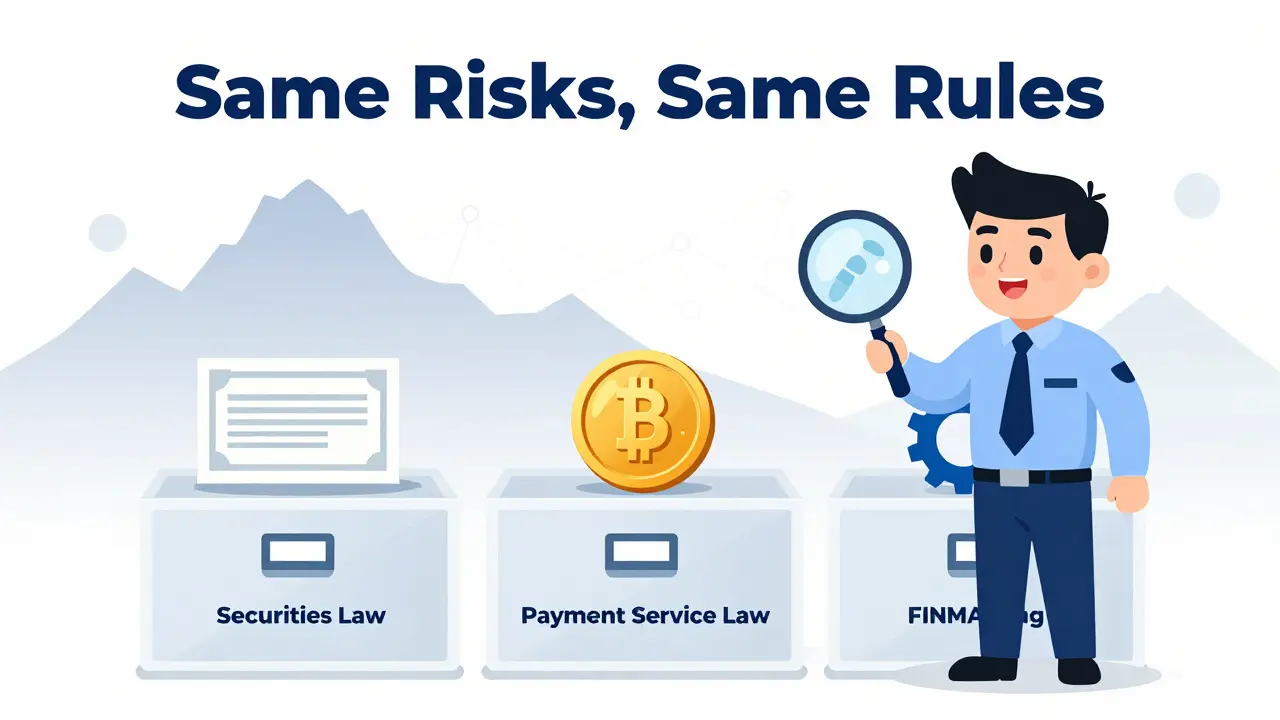
The core philosophy driving regulation in Zug-and all of Switzerland-is straightforward. The financial regulator, FINMA (Financial Market Supervisory Authority), operates on a principle called "same risks, same rules." This means they don’t create a special, separate lawbook for every new type of cryptocurrency. Instead, they look at what the token actually does. Does it act like a stock? Then it follows securities laws. Does it act like a currency? Then it follows payment service laws.
This approach removes the guesswork. In many other countries, regulators might ban a project because they don’t understand it. In Zug, FINMA categorizes cryptocurrencies primarily as asset classes rather than restricting them outright. This distinction is crucial. It allows projects to launch without fear of sudden bans, provided they meet transparency and anti-money laundering (AML) standards. For a startup founder, this predictability is worth more than any tax break.
The DLT Act: A Legal Home for Tokens
If you want to understand the modern framework, you have to look at the Distributed Ledger Technology (DLT) Act. This legislation became effective on August 1, 2021, but its impact has only grown since then. Before this act, tokenized assets existed in a gray area. The DLT Act created specific legal frameworks for these assets and established licenses for DLT-based trading venues.
A major milestone happened recently. On March 25, 2025, BX Digital received the first-ever DLT trading venue license from FINMA. This wasn’t just paperwork. It allowed BX Digital to enable multilateral trading of DLT securities. What does that mean for liquidity? It means institutional players can now trade tokenized assets with the same confidence they use for traditional stocks. This license sets a precedent. We expect more platforms to apply for similar authorizations, expanding the infrastructure available to traders and issuers alike.
| Date | Event | Impact |
|---|---|---|
| 2016 | Zug accepts Bitcoin/Ether for taxes | First municipality globally to accept crypto for public services |
| August 1, 2021 | DLT Act becomes effective | Legal framework for tokenized assets and trading venues |
| March 25, 2025 | BX Digital gets DLT license | Enables multilateral trading of DLT securities |
| June 6, 2025 | Federal Council approves AEOI | Crypto data exchange with 74 countries starts Jan 2026 |
Taxation: No Capital Gains, But Watch Wealth Tax
Let’s talk money. One of the biggest draws for individuals moving to Zug is the tax treatment. Here is the good news: individual cryptocurrency investors pay no capital gains tax on crypto transactions. If you bought Bitcoin in 2020 and sold it for a profit in 2025, you keep that profit. The Swiss Federal Tax Administration (SFTA) treats digital assets similarly to other personal property, like gold or art.
However, do not get too comfortable. There are two catches. First, if you earn crypto through mining or staking, those earnings are considered income. You will pay income tax on them. Second, and this is often overlooked, all cryptocurrency holdings are subject to annual wealth tax. Since Switzerland uses a progressive wealth tax system, large portfolios can become expensive to hold over time. You must declare your holdings accurately. The SFTA provides transparent guidance, so there is no ambiguity about reporting virtual currency sales or transfers.
As of April 2025, there is no specific digital service tax or blockchain-focused tax legislation. This maintains favorable conditions for businesses, but the lack of specific laws also means you must rely on general principles. Always consult a local tax advisor before making large moves.

Stablecoins and Banking Integration
Stablecoins are tricky everywhere, but Switzerland handles them with a "substance-over-form" approach. FINMA looks at the economic function of the token. If a stablecoin acts like a bank deposit, it triggers licensing obligations under the Swiss Banking Act. If it acts like an investment fund, it falls under the Collective Investment Schemes Act. There is no separate "stablecoin law," which some might see as a gap, but it ensures comprehensive oversight based on existing, robust financial regulations.
This regulatory clarity has encouraged major banks to step in. PostFinance, a systemically important Swiss bank, became the first to offer customers 11 different cryptocurrencies for storage and savings plans. Meanwhile, BX Swiss collaborated with giants like Credit Suisse, Pictet, and Vontobel to test blockchain-based trading. They issued tokenized securities on Ethereum, traded them on the BX Swiss platform, and settled directly in Swiss francs. This connects the Ethereum blockchain with the Swiss Interbank Clearing system. It proves that traditional finance and crypto can coexist safely under Swiss rules.
International Compliance: The AEOI Shift
You cannot ignore the global context. Switzerland has always been associated with banking secrecy, but that era is ending for crypto. On June 6, 2025, the Federal Council approved the automatic exchange of crypto asset information (AEOI). Starting in January 2026, Switzerland will share crypto transaction data with 74 partner countries. The first actual data exchanges begin in 2027.
Does this kill the "crypto haven" vibe? Not necessarily. It kills anonymity for illicit activities. For legitimate businesses and investors, this enhances trust. It shows that Zug is serious about compliance. When major institutions see that Switzerland is combating cross-border tax evasion, they feel safer investing billions. The combined valuation of top blockchain companies in Switzerland and Liechtenstein reached USD 584.33 billion in 2023, up 56% from the previous year. That growth suggests the market believes in the long-term stability of this regulated environment.
Real-World Adoption Beyond Regulation
Regulations are one thing; daily life is another. Zug leads by example. Since 2016, the city has accepted Bitcoin and Ether for council services and tax payments up to CHF 100,000 annually. This isn’t just a marketing stunt. It normalizes crypto usage for citizens. Other municipalities follow suit. Lugano, for instance, announced plans to make Bitcoin, Tether (USDT), and its own LVGA Points token legal tender for city transactions. They even formalized collaboration with Tether for tax payments.
Even the Swiss Federal Railways joined in. Since 2016, you can buy train tickets with Bitcoin at over 1,000 ticketing machines nationwide. Transactions range from 20 to 500 Swiss francs. These initiatives show a decentralized regulatory approach. Cantons and municipalities implement crypto-forward policies within the federal framework. It creates a living lab for digital asset integration.
What This Means for You
If you are a developer, Zug offers a clear path to build compliant products. The DLT Act gives you legal certainty for token issuance. If you are an investor, the lack of capital gains tax is attractive, but remember the wealth tax implications. If you are a business leader, the AEOI implementation means you must ensure your records are impeccable. Transparency is no longer optional; it is the price of admission to this high-trust ecosystem.
The future trajectory indicates continued innovation support alongside stricter international compliance. The successful DLT license for BX Digital suggests FINMA is ready to authorize more platforms. Switzerland’s model serves as a global benchmark. It demonstrates that you do not have to choose between innovation and stability. You can have both, if you are willing to play by clear, consistent rules.
Is it legal to mine Bitcoin in Zug?
Yes, mining Bitcoin is legal in Zug. However, the earnings from mining are treated as taxable income by the Swiss Federal Tax Administration (SFTA). You must report these earnings and pay applicable income tax rates. Unlike capital gains from selling held assets, mining profits are not tax-free.
Do I pay capital gains tax on crypto profits in Switzerland?
No, individual investors do not pay capital gains tax on cryptocurrency transactions in Switzerland. Profits from selling crypto assets are tax-free. However, all crypto holdings are subject to annual wealth tax, and income generated from mining or staking is taxed as regular income.
What is the DLT Act in Switzerland?
The Distributed Ledger Technology (DLT) Act is a Swiss law that became effective on August 1, 2021. It provides a legal framework for tokenized assets and establishes licensing requirements for DLT-based trading venues. It allows for the creation of legally recognized tokenized securities and enhances investor protection.
When does Switzerland start sharing crypto data with other countries?
Switzerland approved the automatic exchange of crypto asset information (AEOI) in June 2025. The implementation begins in January 2026, with the first actual data exchanges scheduled to start in 2027. This involves sharing data with 74 partner countries to improve tax transparency.
Can I pay my taxes in Bitcoin in Zug?
Yes, the canton of Zug has accepted Bitcoin and Ether for tax payments since 2016, up to a limit of CHF 100,000 annually. Other municipalities like Lugano have also introduced options to pay taxes using Bitcoin, Tether (USDT), and local tokens, demonstrating widespread municipal adoption.
How does FINMA regulate stablecoins?
FINMA regulates stablecoins using a "substance-over-form" approach. Instead of creating separate laws, they apply existing financial regulations based on the token's economic function. If a stablecoin acts like a bank deposit, it requires a banking license. If it acts like an investment scheme, it falls under collective investment regulations.
What was the significance of BX Digital's license in 2025?
On March 25, 2025, BX Digital received the first DLT trading venue license from FINMA. This groundbreaking authorization enabled the multilateral trading of DLT securities, enhancing liquidity and allowing institutional investors to trade tokenized assets with greater confidence and regulatory clarity.
 Finance