

Where you plug in your rigs matters more than the hardware itself. In 2025, the global landscape for cryptocurrency mining is the process of validating transactions and securing blockchain networks using computational power has shifted dramatically. It is no longer just about finding cheap electricity; it is about navigating a complex web of regulatory clarity, tax incentives, and energy sustainability goals. Governments are no longer passive observers. They are actively shaping the industry through subsidies, bans, or strategic partnerships.
If you are running a mining operation, whether it’s a small home setup or an industrial-scale farm, choosing the wrong jurisdiction can wipe out your profits overnight. Conversely, picking the right location can turn a marginal operation into a highly profitable venture. The United States remains the heavyweight champion, but emerging players like Kazakhstan and Iceland are offering compelling alternatives that challenge the status quo. This guide breaks down the top destinations for 2025, helping you weigh the risks and rewards of each.
Quick Summary: Key Takeaways
- The United States leads globally due to institutional support and mature legal frameworks, despite higher operational costs.
- Kazakhstan offers aggressive tax exemptions until 2066 and low energy prices, making it a top choice for cost-sensitive miners.
- Iceland provides a unique combination of near-zero cooling costs due to its climate and abundant geothermal energy.
- El Salvador stands out as the only nation with Bitcoin as legal tender, offering zero capital gains tax on crypto holdings.
- Switzerland and Liechtenstein provide unparalleled regulatory certainty for institutional investors and tokenized assets.
The United States: Institutional Powerhouse
The United States is the largest economy in the world and the leading hub for institutional cryptocurrency mining dominates the global hash rate not because it has the cheapest electricity, but because it offers the best risk-adjusted returns. For large-scale operations, the US provides a stable legal environment, access to deep capital markets, and a mature infrastructure. The Hashrate Index consistently ranks the US at the top for institutional involvement.
However, the US is not a monolith. The regulatory landscape varies significantly by state. Texas and Wyoming have become hotspots due to their pro-crypto legislatures and surplus energy capacity from wind and natural gas. In contrast, states like California have seen miners leave due to high electricity costs and environmental concerns. If you operate in the US, you must navigate federal securities laws enforced by the SEC, which can be unpredictable. But for those who can manage the compliance overhead, the US offers the deepest liquidity and the most robust banking relationships for crypto businesses.
Kazakhstan: The Tax Haven for Miners
Kazakhstan is a Central Asian country that has emerged as a major crypto mining hub due to low energy costs and favorable tax policies has transformed itself from a post-China-ban refugee zone into a deliberate mining powerhouse. Accounting for over 6% of global mining operations, Kazakhstan views Bitcoin mining as a strategic tool to diversify its oil-dependent economy. The government actively encourages this shift by offering lower energy prices and significant tax breaks.
The most attractive feature for operators is the tax regime in the Astana International Financial Centre (AIFC). Crypto businesses registered here are exempt from corporate taxes until 2066. Additionally, personal crypto gains are not subject to capital gains tax. This creates a massive profit margin advantage compared to Western jurisdictions. However, you must be aware of the grid stability issues. During extreme winter months, the government has occasionally imposed curfews on mining farms to prevent blackouts. While the long-term outlook is positive, short-term operational disruptions remain a risk.
| Country | Primary Advantage | Tax Regime | Energy Source | Regulatory Risk |
|---|---|---|---|---|
| United States | Institutional access & legal clarity | Federal income tax applies | Natural Gas, Wind, Nuclear | Medium (State-dependent) |
| Kazakhstan | Tax exemptions until 2066 | No capital gains tax | Coal, Renewable mix | Low-Medium (Grid stability) |
| Iceland | Cooling efficiency & green energy | Standard corporate tax | Geothermal, Hydro | Low |
| El Salvador | Bitcoin legal tender status | Zero capital gains tax | Geothermal, Solar | High (Political volatility) |
| Switzerland | Regulatory certainty (FINMA) | Canton-dependent (often low) | Hydro, Nuclear | Very Low |
Iceland: Nature’s Cooling System
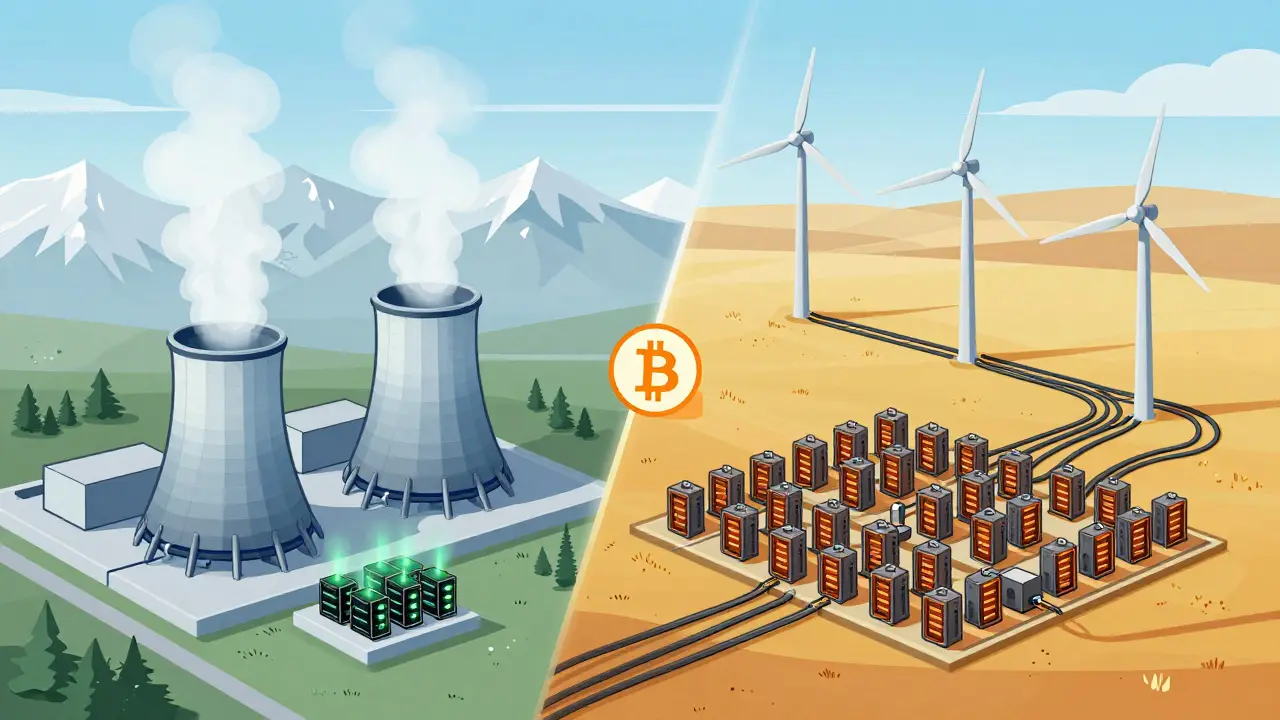
Iceland is a Nordic island country known for its geothermal energy and cool climate ideal for data centers offers a different value proposition. Instead of competing on price alone, Iceland competes on efficiency. The naturally cool climate means you spend significantly less on cooling your ASIC miners, which is often 30-40% of total operational costs. Combine this with an overabundance of cheap geothermal electricity, and you get a highly sustainable and efficient mining environment.
The population density is low, meaning there is minimal competition for energy resources from residential users. The government supports digital industries as part of its economic strategy. However, land availability is limited, and construction costs can be high. It is an ideal location for mid-sized operations that prioritize sustainability and brand image, appealing to ESG-focused investors.
El Salvador: The Bitcoin Nation
El Salvador is the first country to adopt Bitcoin as legal tender alongside the US dollar takes a bold approach. By adopting Bitcoin as legal tender, it has created a unique ecosystem where mining is not just tolerated but integrated into national policy. The country utilizes volcanic geothermal energy to power mining farms, promoting a narrative of "green" Bitcoin. Furthermore, there is zero capital gains tax on cryptocurrency holdings.
This sounds perfect on paper, but the reality is nuanced. The political and economic volatility in El Salvador presents higher sovereign risk compared to established economies. Banking relationships can be difficult to establish for foreign entities, and the local infrastructure may not support the scale of operations found in the US or Europe. It is a high-risk, high-reward play suitable for those who believe strongly in the long-term adoption of Bitcoin as a global reserve asset.
Switzerland and Liechtenstein: Regulatory Certainty
For institutional investors who prioritize legal safety over raw cost savings, Switzerland is a European nation renowned for its financial stability and progressive crypto regulations led by FINMA and Liechtenstein is a microstate with comprehensive Blockchain Act legislation providing legal certainty for tokens are unmatched. Switzerland’s Financial Market Supervisory Authority (FINMA) provides clear guidelines for crypto businesses, reducing the fear of sudden regulatory crackdowns. While energy costs are higher, the stability attracts long-term capital.
Liechtenstein goes further with its Blockchain Act, which provides comprehensive legal certainty for token-based business models. This makes it attractive not just for mining, but for broader blockchain infrastructure development. Banks in both countries are generally receptive to working with blockchain firms, solving one of the biggest pain points in the industry: access to traditional banking services.

China: The Underground Giant
Despite an official ban, China is a major global economy that continues to host significant underground Bitcoin mining operations still plays a substantial role in the global hash rate. Operators run underground facilities in provinces like Sichuan, leveraging cheap hydropower during rainy seasons. China’s historical expertise in hardware manufacturing gives these operations an edge in efficiency and maintenance. However, the regulatory risk is exceptionally high. Operations can be shut down without warning, and equipment can be confiscated. This is not a destination for legitimate, long-term commercial planning unless you are prepared for extreme operational secrecy and risk.
Canada: A Fragmented Landscape
Canada is a North American country with vast renewable energy resources but varying provincial crypto regulations offers vast energy resources, particularly hydropower in Quebec and British Columbia. These provinces have historically been friendly to miners. However, the regulatory landscape is fragmented. Some provinces impose restrictions or outright bans during peak demand periods, while others encourage growth. Navigating this requires careful legal counsel at the provincial level. Canada also benefits from a cool climate, similar to Iceland, though not to the same extreme degree.
How to Choose Your Location
Selecting the right country depends on your specific operational goals. Ask yourself these questions:
- What is your primary constraint? Is it cost (Kazakhstan), cooling (Iceland), or legal safety (Switzerland)?
- Who is your investor base? Institutional investors often require the legal certainty of the US or EU, while private equity might accept higher risks in emerging markets.
- What is your energy strategy? Do you need 24/7 baseload power (US/Nuclear) or can you handle intermittent supply (Solar/Wind in developing nations)?
- How do you handle banking? Ensure the jurisdiction allows easy fiat on-ramps and off-ramps for your business model.
The trend in 2025 is toward jurisdictions that offer a holistic package: regulatory clarity, sustainable energy access, and favorable tax treatment. As governments increasingly recognize mining as an economic development opportunity, expect more countries to introduce targeted incentives. Stay agile, monitor regulatory changes, and always prioritize legal compliance over short-term cost savings.
Is crypto mining legal in all countries?
No, crypto mining legality varies widely. Countries like China and Algeria have banned it, while nations like the US, Switzerland, and Kazakhstan actively support or regulate it. Always check local laws before operating.
Which country has the lowest electricity cost for mining?
Countries like Kazakhstan, Venezuela (though high risk), and parts of China (underground) offer very low electricity costs. Iceland and Canada offer competitive rates due to hydro and geothermal power, especially when combined with natural cooling.
Do I pay capital gains tax on mined Bitcoin?
It depends on the jurisdiction. In the US, mined Bitcoin is taxed as ordinary income at the time of receipt. In Kazakhstan and El Salvador, there are currently no capital gains taxes on crypto holdings, making them attractive for profit retention.
Why is Iceland good for crypto mining?
Iceland offers abundant, cheap geothermal energy and a cold climate that reduces the need for expensive cooling systems for mining hardware, improving overall operational efficiency.
What is the main risk of mining in Kazakhstan?
The primary risk is grid instability. During extreme weather events, particularly winter, the government may impose temporary curfews on mining farms to ensure residential power supply, leading to downtime.
 Finance